



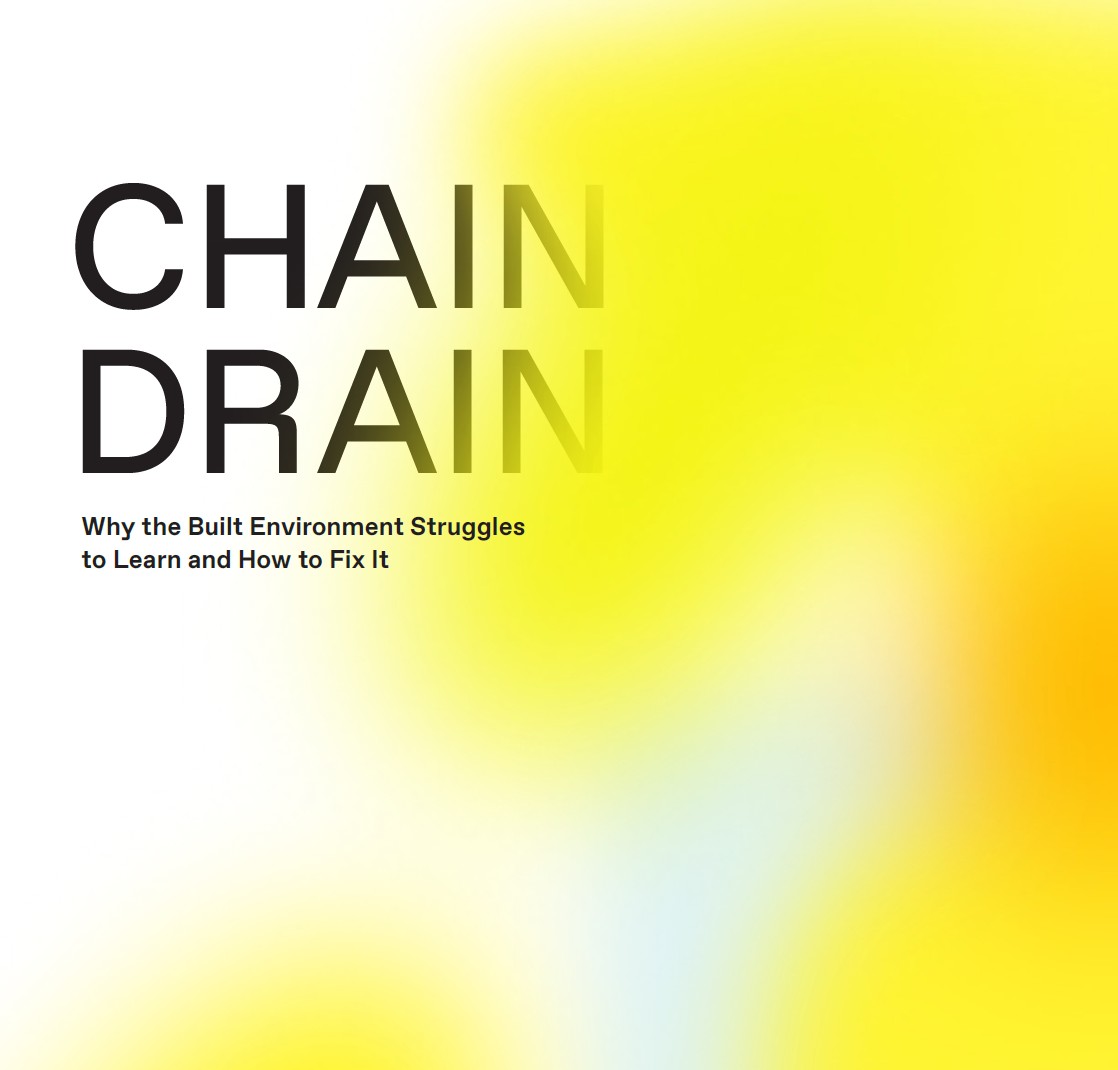
The AECO (architecture / engineering / construction / operation) supply chain is among the most inefficient compared to other global industries, and it is getting worse. We are categorically unable to deliver built assets at the scale and speed we need, and have no idea whether the ones we do build are actually performing well. What do we call this malaise? Chain Drain. What do we do about it? Unfrozen interviews the authors of the paper coining that term: Bryan Boyer, and Greg Lindsay – yes, THAT Greg Lindsay – to find out.
Show Notes
Intro/Outro: “The Chain,” by Fleetwood Mac
--
Discussed:
People
- Bryan Boyer — co-author; Taubman College, University of Michigan (transcript: "Taubin College")
- Greg Lindsay — co-author; U of T School of Cities
- Frank Duffy — DEGW co-founder, past RIBA president; RIBA obituary
- Stewart Brand — How Buildings Learn, source of the shearing-layers framing
- Bobby Fijan — co-founder, The American Housing Corporation
- KP Reddy — founder/CEO, Zero RFI; ex-Gehry Technologies
- Boon Sheridan — permitting tech lead, EPIC
- Jon Buerge — president, Urban Villages
- Jeanne Gang — Studio Gang
- Joanna Frank — Center for Active Design
- Federico Negro — CEO, Canoa
- Astro Teller — X, the Moonshot Factory
- Masayoshi Son — SoftBank Group
- Adam Neumann — WeWork co-founder
- David Graeber — Bullshit Jobs
- Austan Goolsbee — Federal Reserve Bank of Chicago
- George Romney — HUD Secretary behind Operation Breakthrough
Companies & organizations
- Anori — company site / X project page; spun out of Alphabet's X with $26M led by Prologis and Builders
- Consigli AS + AECOM — AEC Magazine on the acquisition; Norwegian AI start-up acquired for roughly $390M
- Zero RFI — zero-rfi.com; backed by General Catalyst, built on its Foundation Zero intelligence layer
- The American Housing Corporation — americanhousing.com / Fast Company profile
- Urban Villages — urban-villages.com
- Studio Gang — studiogang.com
- SHoP Architects (Chris Sharples) — shoparc.com
- Gensler — gensler.com
- Autodesk / Revit — autodesk.com/products/revit
- Katerra — Wikipedia; raised more than $2 billion before going out of business
- WeWork — Wikipedia
- EliseAI — eliseai.com (transcript: "Elise AI")
- Canoa — canoa.com
- EPIC (Environmental Policy Innovation Center) — policyinnovation.org
- Permitting Tech — permittingtech.com
- AvalonBay + Equity Residential → Vivmark Residential — Commercial Observer; more than 180,000 rental apartments, ~$71B enterprise value
- JPMorganChase / 270 Park Avenue — project page
- Bilt Rewards — biltrewards.com
- PCBC — pcbc.com
- Council for Quality Growth — councilforqualitygrowth.org
Papers, reports & standards
- Chain Drain: Why the Built Environment Struggles to Learn and How to Fix It — chaindrain.netlify.app; Boyer & Lindsay (2026), University of Michigan white paper built on dozens of AECO-sector interviews
- 2026 Permitting Technology Landscape Report — permittingtech.com; inventory of 305+ permitting technologies
- Construction Disconnected: The High Cost of Poor Data and Miscommunication – Autodesk / FMI, 2018
- Fitwel — fitwel.org
- LEED — usgbc.org/leed
- WELL Building Standard — wellcertified.com
- Toyota Production System — Wikipedia · Six Sigma — Wikipedia
- Operation Breakthrough — HUD User archive
Policy
- 21st Century ROAD to Housing Act (H.R. 6644) — Congress.gov; reduces barriers to building and targets institutional single-family buyers
- NYC Local Law 97 — nyc.gov
- CEQ Permitting Innovation Center — permitting.innovation.gov
Cultural references
Show Transcript
Greg Lindsay 00:25
Hello and welcome to Unfrozen episode 129 Chain Drain. I'm your co-host Greg Lindsay,
Daniel Safarik 00:31
and I'm Dan Safarik. And today we have two very special guests on our program. Brian Boyer is the associate professor of practice in urban technology at Taubman College at University of Michigan, and Greg Lindsay, whose name you might recognize, is urbanist in residence at the University of Toronto School of Cities. Together, they have written a paper called "Chain Drain: Why the Built Environment Struggles to Learn and How to Fix It. It is making some waves. Welcome, guys.
Greg Lindsay 01:02
Hi. It's good to be here at my own podcast. It's great. If this were a table, I guess I'd be sitting on the third side of it somewhere in between. But yes, I look forward to asking you both questions and myself questions and answering them during this episode. I was gonna say, why do I ask the first question to Brian, my co-author? Brian, what is Chain drain. What is the paper?
Bryan Boyer 01:23
Perfect. So, chain drain is the condition of disconnection and discoordination that exists across the work of the built environment, from conceptualizing something that's going to be built, from designing and planning it to actually building it to operating it. That whole supply chain, that whole process, has been sliced into narrow little pieces, and that makes a lot of sense when we're building exactly the same thing over and over again. Perhaps it makes a lot of sense when the one thing that you care about is cost, but if you have broader goals, for instance, outcomes such as resilience or social inclusion or health, and you need the intelligence that's in the design to end up as intelligence in the constructed constructed building and in the place that is operated and utilized every day, then disconnection and discoordination become your enemy, and so chain drain is a study of that condition across the supply chain and looking at some scenarios in the paper around how we escape that that condition.
Daniel Safarik 02:37
Good. I mean, I think it is pretty well known and accepted across the industry, starting with a pretty seminal McKinsey paper over 10 years ago that said, you know, basically the construction industry is like the least efficient major industry in the world, and it's getting worse, as you guys have pointed out. How much worse is it getting, and what do you think some of the fundamental causes are?
Greg Lindsay 03:03
That's a great question. So McKinsey like drops these papers regularly. I think we cited the last one from 2023. They dropped a new one in July that we missed because we'd already closed the research for this paper. So I should go back and see their update on that. But yeah, there's some great studies out there. There's a famous Autodesk RMI one that showed that like like 14 hours a week by sort of AEC executives were being just spent on the admin. So Chain Drain really captures the fact, like so much of the work in the built environment sector is just managing and communicating about the work, which shows up as change orders and RFIs. And you know, our listeners probably know this even better than I do. It's been it was a real education writing this paper with Brian. I really feel like I have like a complete understanding of the industry that I really never had before, and seeing all these handoffs and how these pieces fit together. So yeah, so then then the overall there's a paper by Austan Goolsbee who was part of I believe Obama's White House Council of Economic Advisers. After that wrote that like yeah you know there's there's various measures and a lot of them are apples to oranges but like you know by some accounts there's been like a 30% decline in productivity over decades, and meanwhile, everything that gets manufactured has gone up between you know 90 and 200% across those things. And so yeah, in the 70 s, you can go back and look at the Toyota production system, auto manufacturing, repeatable processes, Six Sigma tolerances, all ways to perfect this. Electronics, then of course, which we'll come back to in a moment, and then and then of course software, and that software to me is the really piece of like of disconnection here, where you know I've been a critic of smart cities and smart buildings and things, and did did papers on them where American consumers never really understood the point of a smart home, for example. Well, yeah, we live in an environment where we all collect data, or data is collected from us at all times. We have these sensors that we carry around us everywhere we go, but we do not collect any data from any projects. Two years ago, I was talking to the board of directors of Gensler Private Presentation to them about what AI could do and asked them like how many Gensler projects were they collecting actual real time data from. They guessed maybe 10. They were getting like 10 sources of data from somewhere, so. Yeah, you have a chain that like does not even even understand how it's being how its products are being used at the far end, and so therefore, yeah, you just get the and so the gulf widens, right? The conditions are getting worse. Climate resilience is more needed than ever. Europe is burning. We have El Nino effects, and so and then you have destruction of the built environment, and you know, and it just becomes this whole sort of spiral. So yeah, so you know conditions are getting worse, Dan. Even as we hope that we can make them better,
Bryan Boyer 05:24
I think there are two other things that we could add here. So one, Dan, is the question of how do we talk about that whole span of work again, from the the earliest inkling of like we should do a thing somewhere, through to we're now in that thing. It's a building. It's operating in this particular place or a public space, for that matter. All those different fields have very different languages, and even though they they touch the project at different phases, sometimes it's hard to like have a unified conversation or to have unified data about all of that. So, you know, the McKinsey report focuses on construction, but has less to say about the specific niche of the design and plan portion of the work. And so, one of the things we try to do in the paper was to zoom out and say what ultimately matters for society is the performance of the entire sector, not one industry, but the sector. And so then the next piece of that is, you know, while it's hard to give you some specific data points on how it's not getting better, I think it's generally easier for us to say we don't have proof of particular performance on many areas other Than any one individual silo, so we can say like we're building, you know, probably safety records have gone up on construction sites, right? Like similarly, the level of insulation in structures has gone up because it's been enforced by code, and that has been positive. So, like, there is movement. It's that that movement is captured or or isolated in a one small zone, and is not necessarily adding up to like, wow, hey, our workplaces are making us healthier, or our houses, our housing is making us more connected as a community. Those kinds of large outcomes are still missing.
Daniel Safarik 07:23
This is so interesting because I mean every conversation, and let's just take commercial real estate as a sub sector of the AECO continuum, right? Everybody talks about performance, but you know we used to have this thing that we talked about called the post occupancy evaluation, that seems to have gone out of fashion. Is performance just a buzzword? Do people not see it as a worthwhile investment to engage in performance monitoring? I mean, you mentioned the statistic with Gensler. Kind of sounds like yeah, people have bought out of that for some reason.
Greg Lindsay 07:59
All right, I'll take this first because you know I'm a big fan of Frank Duffy, so you know obviously DGW developing the post occupancy study, and we'll get we'll get to the scenarios. We'll have to unpack them in a little bit here, but you know one of them is you know sort of explores like what if you don't build, and that's very much a Duffy pointism. I think he covered in his last book Work in the City from 2009, was like pointing out that like you know the sort of mindless production of space and buildings without without any connection to how end users were using them was going to lead to a crisis, and like that crisis very much came. So in this case, you know, one of the things we talk about is yeah that that discoordination piece or sorry the disconnection piece where the owner of the asset never passes data back through the chain. Well, in many cases, those owners don't know that performance either, and this touches on work with my friend Phil Kirschner, who was at WeWork and Credit Suisse and their workspace practice, and did this. You know, the occupants don't collect any data. Like one of the buildings that pops up in our report is 270 Park Avenue, Shaping Work and Chase headquarters, most expensive building in the world. That's overexaggeration, but $4 billion skyscraper. It's well certified, etc. No one knows who and how they are using that space. Diamond has, in fact, mandated five days a week in the office, so it's very nice and luxurious. But no one really knows that. And so, you know, one of the things we talk about is like there's an opportunity here, and we talked to Joanna Frank, for example, CEO of the Center for Active Living-I forget-they run the FitWell standard. We'll have to fact check that in the show notes. But um, but in her case, yeah, she's got a client, a mystery client that would not give permission to talk to us. That is basically taking their historic data set and building their own models on it. And so one of our hypotheses is like, yeah, it's like eventually these kinds of standards, like LEED and WELL and FitWell, will force real-time performance of the actual building of occupancy. You can start to imagine some fun AI scenarios, which we can cover too, of like you know, like local law 97 in New York, you know, which of course carbon emissions. Right now, it's a very painful annual audit. Well, you can start to imagine if you integrate these building systems, the cities. Agents can start asking, like, "Are you in compliance now? Are you in compliance now? And do these kinds of things, and and and integrate these systems together. So I, one of the most hopeful scenarios I have out of this paper is that you know that maybe there's a lever here with post occupancy evaluation. But the thing I'll the thing I'll finally end there is like is like yeah, my work with Phil is that a client like a J.P. Morgan Chase, where that performance data lives, it's then split up. There's chain drain inside the company in HR and real estate and IT, and they don't even know what performance means. So how is anybody else in the chain supposed to know this? It starts to become fractal once you see chain drain. I'm sure Brian's the same way. You start to see it everywhere, and I'm seeing all these other different industries as well about those kinds of things. But yeah, we need we need a super powered post occupancy evaluation regime.
Bryan Boyer 10:44
So one of the tensions that exists in this study is around essentially who wins and who loses, and so sometimes the post occupancy discussion ends up being well, let's figure out how the architects messed it up, and if that is the answer, then understandable people, you know, people are a little bit afraid of it. But if we flip that, so as somebody who is trained as an architect and and still is a partner in an architecture firm, very small one, we do you know bespoke projects in residential and and cultural and hospitality, but you know, with if we think about the way that projects get presented, how do you hire an architect and then how do you approve an architect's work? Well, there's not a lot of data there. There's no post occupancy that's happening, so it's hard for an architect to say we told you that it's going to increase productivity or increase serendipitous collisions or increase visitors, whatever that is, and we verified it because that data is something that, and in the very best case situation, is the parties are separated by a contractual divide, like the architect doesn't have access to the turnstile numbers that the owner operator does, and and yet if they did, if they did have access to data of how the space was used, then it would still be hard to interpret, you know, what what was the contributing factor from the architecture and from the design versus everything else that's going on, like including the weather and the mood of the employees and all the things that are beyond the the control or the scope of the architect? But one thing that it would do is produce the possibility of making arguments for design based on past performance, and so I think one of the kind of longer-term questions that I'm really interested in is how do we essentially resurrect post-occupancy as a source of power for design firms to say we are really good, and it's not just the renderings and the awards from other architects that prove that; it's also some kind of data-based argument, and the reason why we think that's essentially inevitable is because a version of that happens in essentially every other decision that you make about your life. If you go for surgery, you look at the performance of that hospital or the individual surgeon. If you're buying a car, you think about it. If you're looking at you know investments, you're certainly looking at the past performance, so it it does feel like something that kind of got maybe minimized or abandoned in part because of the power dynamics that are implied by it, and in part because it's really hard. And so we're basically saying it's time for us to engage on the hard thing, and the power dynamics are something that we can figure out if we operate at the level of the supply chain instead of dwelling in this party versus that party in the individual contracts.
Greg Lindsay 13:50
Slipping back into my role as co-host for a second, where I often model myself on Fred Willard and Best in Show. Are you telling me like there's no equivalent of JD Power or you know Morningstar for the entire ACO stack? That is kind of crazy to think about. Like, there's no rating system, no no ability to actually judge that, no third party that's built a fortune on being able to basically try to do third-party quality control in the industry. I mean, there's an opportunity right there.
Bryan Boyer 14:13
I mean, I'm looking at both of you, wondering if you have answers. I I don't know of any. I think we should. I'm
Greg Lindsay 14:18
gonna call Andreessen Horowitz right this session
Bryan Boyer 14:20
right now. Yeah, I think we should just
Daniel Safarik 14:21
start a company and like that's it. That's that's the play. Yeah, yeah. I think about the ways that the people. I mean, I I was on the architect side of the equation for a long time. You know, putting together proposals. What did they want to know? How many times have you done this before? And what was the project scale? That was it, though. I mean, they didn't ask how well the projects perform because they know nobody knows. It's basically a vibe decision. It's like, do I get along with this architect, and have they been able to deliver projects? I mean, the only metric was, was it remotely close to the budget or cost? Also,
Greg Lindsay 15:00
it's also extremely telling about architects in particular. We should talk about other pieces of the chain as well. But their own disorganization-that like one of the first uses of AI of large language models by architecture firms was to dump PDFs of past RFP submissions into the LLMs and try to surface participants in those projects to figure out how to answer their next RFPs. Like they don't even know their own people. Their tacit knowledge train inside the firms themselves is terrible. We focus on the linkages, but there's a lot that's that's going out the door, or they're just too busy to
Bryan Boyer 15:27
prioritize it. Yeah, Dan, the way that I describe what you were just talking about is that although architects have an undersupply of data about their performance and their work, they have an oversupply of charisma, and that's what gets used. You know, that's that's charismatic renderings and charismatic principles are the ones that win projects, and that's because that's the best thing that we have, and it's the best thing that the clients have also to to make those decisions. And so this again is why I think like that's a true description of the world that we live in right now, but it is so far off the norm of other important decisions that we make as families, as businesses, that I just can't imagine that that's going to be tolerated for all that much longer. You know, is it going to change next year? No. Is it going to change in 10 years? I don't know. Is it going to be the norm in 50 years. I sure hope not.
Daniel Safarik 16:22
Yeah, I mean, I want to put in a little bit of a bid for charisma since I feel like I might have some. But you know, yeah, is that a way to make all your business decisions and to evaluate actual performance? Probably not. So let's talk a little bit about some of the big four technologies that have been buzzed in the last couple years, with the exception of AI, which is like its own category. So you have building information management (BIM) augmented virtual reality, prefabricated construction, and 3d printing. Why have these not delivered the promised revolution?
Greg Lindsay 17:00
I think we call in the paper like was it or one one draft we call it the dream of 1997 and the dream of 1970. Bim was the dream of 97 of building like you know the one ring to rule them all total model that Chris Sharples of Shop said you can go from like conception down to the rivet and have complete specification all the way through and of course Autodesk bought them in 2002 and now it's like you know one of the ultimate examples of vendor lock-in, et cetera, there. But like my understanding, and I've never, you know, I've never used Revit my whole life. But my understanding is like basically it's a drawing tool. It is not the complete end-to-end process. And that's again, we talk about like where AI comes in in a moment here, because like that sort of resurrects the dream of 1997. But but it is interesting. Outsiders to the industry look at BIM, like and like andreson Horowitz, the venture capitalists put out this essay, and like this, the scandalous title was "Every Building You've Ever Set Foot in Was Designed by Software, made in 1997, which you know in the valley is inconceivable. Yeah, so we're like, like yeah, you're walking into buildings made with Winamp, kind of thing. It's pretty fun. I know there's been updates since then, but that so there's there's that dream of the notion of like yeah, you know some of the some of the architects we talked to, like Sharples and others, debated amongst themselves about you know could you resurrect the dream of BIM? Could you build the complete model that would go across the chain to do that? And we'll talk about that because chain training can't be solved by any tech. It is a structural strategic function. Like you know it's not the reason chainring exists is not because of technology. It's because of accountability. You can't. No one can force the whole chain, but we'll come back to that. And then with with modular, you know, that that's the dream that goes back to 1970 of like you know prefabricated housing. George Romney, the original Secretary of Housing and Urban Development under Nixon, did Operation Breakthrough and tried to do this. And yeah, you know it didn't didn't quite work out there in that particular case. And it's interesting to see the waves of startups, particularly modular, and they factor into one of our scenarios. You know, Katera was like the last great mega example of this, and I just think it's really interesting that you know Katera gets portrayed as just pivoting its way into oblivion and has many problems. But like Katerra tried to take the entire chain and put it on a single balance sheet as a way to fix chain drain by internalizing it, and yeah, even with $2 billion of Miyoshi Sun's money, that wasn't going to be enough. But I don't know if Brian has to add there. I mean, ARVR is interesting too. It is interesting to see firms uses for walkthroughs. But but yeah, it's the question of like you know, can you do connection? And when it comes to the modular piece, you know, or manufactured housing, which was addressed in the Road to Housing Act, I think Brian could talk about it. Like the idea of going from prescriptive codes to reformative codes. Can you spec it in a factory, inspect it once at the end, and you can start to solve some of that drain by internalizing the production environment at least?
Bryan Boyer 19:32
So, Dan, when I look at the four technologies that you laid out, the first two, BIM and augmented reality or extended reality as a whole category, I think I would roll those up to generally tools for making decisions about built projects, and then prefabricated construction and 3d printing are around essentially controlled conditions. So trying to achieve some kind of quality assurance and some kind of efficiency in the. The execution end of things, and again, this is one of the reasons why we tried to zoom out and look at the sector as a whole. Because I think it's pretty fair to say that decisions about the built environment are tough to make because they are multidimensional. They're involving all sorts of different stakeholders and considerations, often weighing scenarios with lots of different factors, and the software because it generally is from 1997 or worse has been kind of under supporting that decision making, and so BIM is like the dream. But I'm really inspired by all sorts of tools that help people model scenarios, even if it's like, what if the staircase were like this instead of that, or what if the building massing was like this instead of that? What are the implications from a beauty standpoint, from a sunlight standpoint, from a leasing standpoint? And so, what we see now in the newest round of tools. There's still a bunch of investment in BIM or companies that are trying to perfect BIM, but there are also a bunch of tools that do essentially like early feasibility and and conceptual design. And the most promising piece of those, from my perspective, is that they're adding dashboards on top that allow you to look at project outcomes alongside the kind of technical design, and that that lives in a format that can become the system of record. So BIM is kind of trying to do you know the the coordination piece that folks can make decisions about which building systems go where and how you coordinate and stage and deconflict and all of that, but I think in isolation of the bigger question of like what's this project going to do from a performance standpoint, it's still like just kind of a better screwdriver, or it's it's a better drafting desk,
Daniel Safarik 21:58
right? And I also think I think you're right that the the issue really isn't that, oh, you know these individual pieces of technology have failed to deliver the revolution, you know because, you know for whatever reason about their their processing capability or the amount of data that they intake. I think there's a is a cultural and philosophical problem that has persisted, which is, you know, the very structure of the profession is you know architects want to make something that yes of course is useful and well used but in the end you know they want it to sort of have their signature mark and be beautiful, whereas you know the the criticisms you hear about anything that is mass produced in the built world is oh it's spreadsheet urbanism it's spreadsheet you know. It's just some institutional, you know. What you get is these, you know, five over ones everywhere. You know, these these cookie cutter developments, and people don't necessarily want that either. I mean, I think what you guys are saying is even those things aren't really actually proven to perform well. It's just something that a bank can understand how to finance and do over and over again, but that's even even that is not necessarily with the level of evidence that would allow it to be a well-performing asset for everyone involved in the chain. Maybe just the person who financed it.
Greg Lindsay 23:16
So before we keep going down the text tag, I'll just note that for this report, like we married sort of a qualitative and quantitative approach. Like Brian built this entire interactive research database, which we'll put in the show notes, where you can sort of analyze all the various startups out there. But then he tasked me with like basically interviewing 30 people over a month, and so we talked to architects, structural engineers, we talked to owners. I think we'll keep them anonymous for these purposes there. And but yeah, every every sort of piece of the chain. And was interesting from the owner's perspective. To your point, there is like, yeah, they they you think they'd be the ones in a position to basically solve chain drain the hard way by peering down into that into that stack and tightening tightening up the chain there. And in most cases, they're not that interested. They just want to make sure that they're repeatable financialized assets. Just keep churning out regularly, you know, mostly on time kind of thing. And to your point there about you know like yeah about housing, just thinking about this whole piece about you know modular buildings. I just think it's fascinating that we're all using like standardized iPhones. We all have one in our pocket. Everybody in America seems to drive a silver Toyota rav4 or maybe some electric equivalent, but homes are unique and special and that sort of thing. It's it's like the industry's trapped in a sort of a cultural norm there, but but yeah, it's it's going to be interesting. From the the owner has to take charge of this. They have to basically change in the end. They have to change their own approaches to this, and it has to be structural because one of the things we found is like yeah, there's examples of enlightened and empowered owners and individuals who can force outcomes from individual projects, but without some sort of mechanism or or yeah tying into the lenders and investors to basically enforce and prove out performance, you're not going to be able to do it. One example I talked to an interview didn't make it into the piece. It was John Burge. He runs Urban Villages. He's the owner of Populous in Denver, which bills itself as the first carbon positive hotel. Like they literally bought a ton of carbon credits. Genie Studio Gang, and so yeah, so they bought this, so they so they enforce it. But I was making the case to him: this is exactly the kind of test case, right? Like, if your appeal is to younger travelers who want to stay in a carbon positive building, wouldn't it be awesome to have the kind of performance data from the building to show them, like, look, look at us in real time? And he agreed that would be awesome. They don't have it, kind of thing. But that's the kind of piece where, like, that is where a performance metric ties directly into a financializable marketing metric, and you could do that kind of project. But, but yeah, he's the rare he's the rare breed of owners. You know, that's there's still time that's going to take.
Daniel Safarik 25:33
I mean, I think it's perfectly okay that we continue to have rare breed owners who are you know pushing the envelope. We need that. It's just and not everything that they do that is going to be interesting to people is going to be repeatable and and scalable, and that's okay. But I think if the if the whole industry doesn't move forward in terms of productivity, we're just not going to be able to achieve any of these major goals like helping with the housing crisis and making stuff more affordable. That's that's the the big obstacle.
Bryan Boyer 26:06
This is Dan. This is the most important point for me, which is I think too often, or actually, I'll just speak from prior experience. So when I've been talking about some of these ideas with colleagues who are in a architecture and design space because that's you know the universe that I know best. Sometimes there is a a mournful response of you know almost assuming you want to make everything automated, and then it will just produce five over over ones, and it will just be about efficiency, and it'll just be about you know whatever the asset owners want, and instead, what I would offer is the opportunity here is to think about automating, accelerating, or eliminating the bullshit work, to use a graver phrase, so that we can spend our time on the things that actually matter, which is you know doing something bespoke in this location that this location alone needs, and that cannot be automated or reduced. But we have to find a way to buy that time. It has to come from somewhere. And the answer right now is we buy that time by entertaining really, really expensive design teams and really, really expensive construction. And so it's a luxury good, and that's a shitty outcome.
Greg Lindsay 27:21
I was gonna say that brings us to the technology of the moment that people are arguing can automate away bullshit work, which is artificial intelligence, of
Daniel Safarik 27:27
course,
Greg Lindsay 27:28
large language models, world models, etc. There.
Daniel Safarik 27:30
Meet our new intern, Claude.
Greg Lindsay 27:33
There you are. Well, you know, it is it is interesting. Keep you ready. So you know, one of the one of our interview subjects apparently he ran Gary Technologies back in the day. Venture capitalist has a company called Zero RFI, where where in his case, to to our point earlier there, from strategic standpoint, he's not building and selling software. He's he's bought owners reps companies and is basically going to become a mercenary for hire for project owners to basically use AI to enforce compliance of the chain. But in this particular case, one of the things that KP talked about is like yeah, there was apparently a 3000 person firm that like locked out AI tools because they didn't want people using unauthorized versions of Claude. So he was using as an example of the insanity inside this sector at the moment. But um, one of these we looked at AI for this whole piece, which of course like you know hangs over. And I'm here in Atlanta actually to talk tomorrow, August 14, because this will be in the past to the Council for Quality Growth about AI in the built environment, and yeah, one of the things we found is like you know you can't even have a common discussion about AI inside the sector because it's a microwave. Like it, if you just apply it to your current practices, you just do things faster or produce more, and it's vibrating at different frequencies where you are in the chain. So it's like it's really useful. At the beginning, we found people built great feasibility tools and land selection tools and things like this. It's really powerful at the end of the chain, like a lot in like multifamily operations, like Elise AI, yeah, or like, but I mean, like, but just like a you know prospects into your sales funnel and you know voice AI agents and stuff that can field calls from people and stuff. You know, this is like there's this huge merger, Avalon Bay or Avalon and Equity Residential. Just Vivmark is the new one, but they have 180,000 apartments now under a single control, and a lot of them are on AI. So I think we're starting to see this consolidation and scale starting to happen at that end of the chain because you can drive it. But in the middle, it's just all over the place. You know, architects. We talked to one architecture firm. They're producing more options for clients. What are you doing with that time? They don't know. Engineers, they're finding incredible gains in this because you know you're solving for equations, and so it's just vibrating there. Like, and you know this gets we maybe get into the scenarios from here because yeah, this is where it plays out of like how are you using those tools to interact with your own firm and your and the other pieces in the chain, and like who's going to set that agenda? I think is going to be one of the really interesting questions. But I don't know, Brian. What's your thoughts on AI? Well,
Bryan Boyer 29:46
so this brings up an important point from the educator standpoint, right? So one of the things that has motivated me from this paper is the work that I've been doing with the undergraduate degree in urban tech, and then now we're preparing to launch. A master's degree of urban technology, which will have the first students next fall. So we're about to go to market with that, and and you know create that as an opportunity for folks. But what the conclusion I've come to is the the questions that we're grappling with on this podcast around how do we make the work better so that the outcomes are better for society? The answer is the one thing I know is that the answer is not more design or more planning or frankly more construction management. It's how do we work, and that is a question of the way that we organize and a question of the talent. And so when we look at using AI in architecture firms, they're at a little bit of a disadvantage, frankly, in that architecture firms generally are staffed with a bunch of people with a background in architecture. Construction management firms are tend to be a little bit more diverse because it's a more accepting industry, but there's a lot of civil engineers, you know, or people that come from a construction management program. So, the to embrace those technologies fully is going to require people who have an education and have some perspective that is is going to be net new. And so, either that's like those firms hiring or acquiring that expertise. So, if you're a big firm, you can have a team that's doing innovation work or digital work, and most of the big acronym firms have a studio like that. Or you can be like Aecom and spend 390 million dollars on Consigli, the AI engineering company from Norway, and just acquire it. What we are proposing with our Master of Urban Technology degree is that there is space for people who exist at the intersection of knowing the domain of the built environment and having a different set of know-how, and in particular being much more fluid with technology, including AI, including data science, and in being able to apply that to the problems within this domain.
Daniel Safarik 32:06
That sounds like a great program. Very very timely. So you guys laid out about halfway through the paper these four scenarios that you've alluded to, which are amusingly tied to the piece of somewhat data technology, the VHS player, but but everyone's pretty familiar with these functions because they persist forward in our existing technology: play, fast forward, pause, or eject. What? Let's describe each of those quadrants a little bit, and then what kind of firms or people fit into these, or I should say would flourish the most under each of these possible four scenarios.
Bryan Boyer 32:46
Yeah. So the play scenario is about the status quo. It's where we are right now. So we called it play because it's the current timeline, just proceeding as is. So those are firms, as I was just describing, where there tends to be it's not not complete, but there tends to be an intellectual monoculture. In other words, it's a bunch of engineers, or it's a bunch of architects, it's a bunch of construction folks. They use digital tools for sure, but they really just use them as tools. It's not changing the the workflow or the organization of the team per se. So if we take that play and we add some greater digital capacity to it, it becomes fast forward. And so in the fast forward scenario, we're talking about design firms, real estate, construction, again actors across the chain using agentic tools, using other machine-readable or machine-operable tools. So, like for instance, if you are in e-commerce, you're using a bunch of different pieces of software that are all tied together by APIs. In the world of AEC, that kind of machine-operated bundle of tools is less common, so kind of embracing digital transformation writ large is the fast forward scenario. Then, if we think about the pause scenario, that's if we take play and we say we want to change the supply chain and the way that we think about where materials come from, how we use those materials, and the outcomes they produce, pause is essentially a hyper adaptive reuse or slower growth proposal, and so that's predicated upon really rethinking the supply chain around local and circular approaches. And then, if we take the fast forward and the pause, and we combine them, so there's a high index of digital transformation and a high index of supply chain transformation. That's the eject scenario, and so eject is the quadrant that has modular offsite construction or. Tools like Enori that combine the kind of governance, the feasibility, and early designs-they're really like taking a big bite out of the chain and compacting it all into one tool that really reorganizes how the work is done. That's the eject scenario, and so the way that we think about it: is that when you're in fast forward and play in those scenarios, you're competing against your peers, right? It's it's kind of the standard competitive dynamics that all firms in the sector are are used to. But if you're in pause or eject, you're competing against the chain itself. You're making a proposal for a different way of delivering the outcomes of the built environment, and so one of the reasons why those are often harder businesses to execute is because not only do you have to be operationally excellent and be great at finding your customers and meeting their needs, you also have to educate them and explain why you're doing things in this better way, and and those often come as well with increased capital needs, and so that's why you know the example of Katera, for instance, really promising but high stakes, and in that case didn't work out. But we see a similar kind of pattern replaying elsewhere, where man, it takes a lot of resource to be able to execute something on that side of the the mapping that we produced, but the potential outcome makes it seductive, apparently, because we see waves of people rethinking it again and again.
Greg Lindsay 36:37
Well, the thing I would add to that, which is great great overview, is you know in the different quadrants of the three sort of viewed well all four quadrants it's about who is effectively the client and how the client works and operates so in play you know because we create these little vignettes for each one in there and so in play sort of assumes like yeah it's going to be non digital vertical integration that you're trying to carve out value so a you know a a very large acronym architecture engineering firm not the one you're legally thinking of suing us I won't even say your name you know basically buys a consultancy they buy you know one of the big three of those and they start designing cities from scratch in Africa the last great urban population boom so they're chasing growth and money and clients and they're leveraging relationships and they're just sort of like you know using the status quo as a moat, so that's that kind of of firm and client. In fast forward, the chain is kept intact, and so it implies some sort of new or empowered owner of the chain. Someone like KP Ready imagines, you know, in our interview, like that basically a Walmart emerges, you know, just like Walmart used its incredible point of sale data to basically both punish and reward the members of its supply chain. I mean, literally, like I don't, I don't think I'd wish on my worst enemies being in the Walmart supply chain. My friend Charles Fishman at Fast Company wrote a whole book on the Walmart effect about the incredible the incredible value that we deliver to you. But wow, the subject, the demands of Walmart and its incredible IT systems. So that's sort of one there. And like, who is that mystery client who achieves that sort of scale? No one's really quite sure. The the best example that people gave was actually, believe it or not, the United States federal government. Chris Sharple's shop, you know, is basically they're bidding for U.S. embassies. I have friends who actually worked on redesigning military bases, base of the future kind of charrettes that have been done for. I forget the one in Florida that was nearly destroyed by Hurricane Michael, for example. Like they're thinking about this, and and in just this past year, the Department of War also put out an RFP on modular housing. Can you deliver it 30% cheaper, 20% more, 20% more quickly for all the barracks we need replaced? So maybe this maybe this sort of emerges where you have the U.S. government as the client of last resort that will get enough of the pipeline going to allow the adoption of these technologies. Over in Eject, it's the transition from projects to products. Productization is the key in Eject. In addition to Catera, which is sort of like one of the ghosts hanging over this paper, which tried to do that a bit with their business model, the other is WeWork, which you know, which you know got laid low because of Adam Newman's shenanigans and their financial engineering there, just taking on too many liabilities. But you know, my same friend Phil Kirschner, we mentioned earlier, he was part of that team there with Federico Negro and others, who now Fed now runs Canoa. They built incredible digital and and fabrication facilities to provision space massively because the business model that we worked was to not build buildings; it was to offer you know co-working and life as a service, and so you basically deliver in a different way. And then pause, you know, is is implies a very different sort of regulatory and/or financial environments kind of thing where there's major constraints on costs, either because it's I mean something as simple as tariffs, you know, basically what it means for construction costs, or you know very binding climate regulation. Some of what we've seen, like in Europe, for example, with various acts in the UK and Netherlands about waste stream diversion, you know, that forces more adaptive reuse. So all those sort of things play out in that regard. And yeah, I'll just say that you know my integrated take on some of these scenarios where I saw things going, and this is from being in San Diego a couple weeks.
Greg Lindsay 39:59
Ago talking at PCBC is like you know now that we have the Road to Housing Act in the states, you know that of course is going to secure single family rentals. You can start to see some sort of fusion, for example, between the fast forward and eject scenarios, where like you know, and I think we talked about this a couple episodes back down, like a built you know BILT, the Loyalty Program for Housing, acquires a home builder and starts deploying these kinds of new membership programs and life as a service, and is doing the land acquisition. You start to see these new integrated models that are deploying housing or other buildings with sensors built in. That is collecting performance data. They are building their models and redeploying, and maybe you start to get the glimmers of this kind of performance, and maybe climate adaptation resilience is the forcing function. Maybe it's insurers who, of course, are redlining big areas of this or offering refunds of this. I know we can speculate on that one, and we do in the in the scenarios there. But but yeah, it's it's it's interesting. I don't think the the chain. I don't think play is a very viable solution going forward. We'll see how far it gets. But I don't know, Brian. If you had to bet, like, what's your favorite scenario or what's your what's what's the least wish chassis, most likely.
Bryan Boyer 41:02
So the play scenario. Just be clear. I don't think it ever goes away. It's just a question of who it's accessible to. And so right now, the the nature of the built environment is that you know essentially only upper upper upper middle class folks are able to build something bespoke by hiring an architect and going through the whole process and that trajectory, I think, will probably continue in the play scenario. So, yes, there will still be Geppetto's workshop designing really fancy houses. That's the business model of Dash Marshall, my studio. We will also have Geppetto's workshop designing fancy museums. Those things always want to be one-offs in there for parties who are going to have the resources to to sustain whatever it costs, but when we look at the so again for for part of the research, we created this database of startups that are touching the AEC spectrum in some way, and then we analyzed each of them as high, medium, or low on the technology axis and on the supply chain axis, and that maps, by the way, to the scenarios. But over when we look at the time series data, and this is a little fuzzy because we use Claude to collect the founding year of the companies. But when I look at that, the earliest company in the database was founded in 2004, and at that point in time, it was around around sorry 70% of the companies were in what we classified as like a medium digital transformation, and 30 in low. And over time, that shifted. So this year, I'm just looking at now. This year, 6% are low, and 60% are medium. And now there's a big 30% are at high. So what we're seeing over time is a movement actually from play up into the fast forward scenario. Again, this is not specific to our industry. Every industry in the world is going through digital transformation and really like internalizing what that means. But in the AAC sector, it's actually happening later than the other fields, right? So, like in 2004, if we were talking about office software, or we're talking about even music or entertainment that was already highly digitalized compared to where we are right now, so so yeah. So fast forward, I think is kind of the default, you know, somewhere between play and fast forward is where we end up. But I I do feel that because of the mounting pressure from housing affordability, from resilience, from all these outside societal needs, that versions of eject are going to happen. So you know, Greg mentioned the federal government as kind of the first mover that could enable the capital investment and kind of backstop the risks for for modular housing or barracks. In that case, you know another example is the American Housing Corporation down in Texas. That's taking instead of saying we're going to do anything you want modular and deliver it, they're saying we are going to have a very particular thesis about a typology of housing in a particular place and a process that we can repeat to deliver that. So I think that's a good example of the kind of hedged eject scenario.
Daniel Safarik 44:31
Yeah, interesting. I mean, I think the obviously the greatest, the greater risks apply to those on the farther end of the eject scenario, right? Yeah, the people who are most willing to invest capital with the potential of having a blowout, like well, like Katerra, you know. But it does seem that that the newer startups are doing this with a perhaps less voracious approach to say we're going to try to control the entire balance. It's more of a question of like, well, we're going to optimize what we can do, and then we're going to be very, very careful about communicating with it, and then we're going to probably share a lot about what the governance is, so that there's a potential for whether it's a literal API or a functional API to connect them to other players in the chain, then it's at least easier to communicate with them and be able to improve the overall, you know, overall chain as it gets longer. If that's a little bit of a dirty metaphor, but I think that's kind of sounds like what these newer startups are trying to do.
Greg Lindsay 45:36
Yeah, I definitely have like if if fast forward is trying to take the whole chain and tighten it, then a jack to sort of like, okay, what what pieces the chain can I internalize successfully? And and in the only most narrow cases, so like American Housing Corporation, for example, is like we're going to do a row house typology in Austin and other Sun Belt cities aimed at millennial starter home buyers, like with like young children, and we're only going to do it on land that we control that's already been entitled. We're going to stay away from that, and we could talk about government piece all day as well too. That's a huge factor in the whole story, of course. And then yeah, and then we've got this modular factor. We're going to do these processes, and then you try to like avoid the rest of the chain as much as you can to deliver it yourself, and then iterate inside of that. Bobby Fajan, one of the co-founders there, used the sort of language of like, you know, yeah, we can iterate in a two-week process. We are not doing a gigantic building where you can barely collect learning outputs at the very end, so that's part of it. I would I would disagree with Brian about Anori about where Anori lands in this because I think it's interesting because Anori, which is the the startup that just came out of the Google Moonshot factory, very tellingly their CEO of it started his career as a basically a software engineer supporting Six Sigma teams at Ford, so like there we can start to see the dream again of that. But you know, to me, the the it seems like the way they position themselves is ultimately sort of basically yeah BIM 2.0 3.0, but also connecting to kind of methodologies like design build and you know integrated project management delivery, where you know you try to compress as many links in the chain at the beginning as you possibly can, and Anoria is that kind of tool to help you visualize all the outcomes and then connect into the systems across the chain there. So I see them as like really sort of the enabling agent of like a fast forward scenario where like the empowered owner uses them as a tool at the beginning of the process to try to set this up and prevent drain later on. But we could we could debate all day. Yeah,
Daniel Safarik 47:23
I I do think it's pretty awesome. This is deep in the papers, so people might not find it unless I point it out. But can we just say that the name of the guy who is the captain of moonshots, the captain of moonshots, his name is Astro Teller.
Greg Lindsay 47:37
Correct, and he is in fact distantly related to Edward Teller, you know, father of the hydrogen bomb. So you know, Silicon Valley, just be in Silicon Valley. That
Daniel Safarik 47:45
just makes it even better.
Greg Lindsay 47:47
Well, and for fans of the HBO show, if you remember, there was a character on there really watched it, but there was a character in Huli who would rollerblade to meetings and occasionally fall through various doorframes. That is, in fact, model and Astro Teller who does in fact do that at Google.
Daniel Safarik 47:59
I am binge watching that tonight.
Greg Lindsay 48:02
Yes. All right. Well, my question for you, Brian, is: Where do we go from here? What do we do with this paper? Who do you want to see it uptake?
Daniel Safarik 48:12
Three comments. Three columns. Take it away there. What
Greg Lindsay 48:14
is your theory of change, Brian?
Bryan Boyer 48:16
Yeah, it's a very fair question. And Greg, you know, sitting on both sides of the interview table, you've witnessed some of these questions as we've gone along the research process. So, you know, one of my motivations here was creating a way to think about and talk about stuff that sits across industries, but needs to ultimately all line up in a literal API or a set of agreements, as you were describing, Dan, for improvement to happen, you know, and that's the type of thing that you say that's like at a 30,000 foot level, and and it kind of risks feeling stupid because of that, and yet we've had 50 or 60 years of proof that you know, despite all these small changes that have been made in all the various industries that we've been talking about today, hasn't really added up to transformation. So we kind of have to figure out a way to have a conversation about that problem and to do it with some some grappling points. And so that's the the you know number one goal of the paper is to introduce some language for that, and and just to validate that that's an okay conversation to have. The second is really a selfish motivation, which is understanding exactly where we are now and where we think the near future may take us, so that we can do our job as educators at the University of Michigan, right? So again, with the master's degree that I'm describing, it's you know there's a big team of us, faculty members, and and otherwise who are working on it. So I don't want to fully attach that degree to chain drain, but let's just say one of the things that that. Graduate degree is trying to address is the fact that everything we've been discussing here is has big implications on architecture and urban planning and real estate, and yet is not architecture, urban planning, or real estate or urban design where we have existing degrees. It is something else, and that that is a necessary condition for unlocking some of these issues, and so then maybe the third thing, if I'm going to have to choose three, is really to start to create a greater tool to discern between companies in the space. There's because digital transformation is coming to the ACO sector later than others. That means we're also earlier in the hype curve, and so when you look at hundreds of companies day after day, you will see there's a lot of claims that are very lightly supported, if supported at all, and there's not as much of a track record of you know demonstrable change, lots and lots of clients, lots and lots of executions of projects, etc. And so, just trying to understand or take stock a little bit where the sector is right now, and and be able to sniff out the bullshit or sniff out the real opportunity better is one of the things that we're hoping to do.
Daniel Safarik 51:19
It'd also be interesting if there was, I mean, we had, if you remember, the internet bubble where I mean, Greg and I were both in the form of one or the one or other financial journalism in the early 2000s. Kind of, there's there's no equivalent of burn rate yet for right for AECO technology. Just as there is no JD power, I'm seeing like two major business opportunities that we just made. Yeah,
Bryan Boyer 51:43
we can call it trucked company, and then it will kind of pass the sensors.
Daniel Safarik 51:48
When are they going to truck? Yeah. Well,
Greg Lindsay 51:51
well, I would just I would just add to Brian's point there about like yeah, all all of these companies is is my friend Boone Sheridan, who related to my Pokemon Go paper. He pops up in all my projects now, but um, but he now works at the or did a whole report at the Innovation Environmental Policy Innovation Center, looking just at permitting tools. And the title of his report, the 2026 Permitting Technology Landscape Report, it's a perfect title. We have a tool for everything, but a system for nothing. And so there's just there's 400 different startups with tools for permitting. None of them are integrated into remotely anything, and now the incumbents are going off and cherry picking them, acquiring them, rolling them up as a feature of their existing stack, or et cetera. So you know, another 1000 flowers have bloomed, and now they're getting cut down or acquired there, and the system goes, you know, continues on its way. So yeah, it's um, it is a question of like finding what is like this larger forcing function, and it's going to have to be some combination of structural change in the industry, and then whatever sort of policy and financial levers go into it. And and I don't know, maybe touched upon this before. To me, the most interesting one by right now, by far, the insurers. Like watching watching Swiss Re and Munich Re and the reinsurers in particular scream about climate, watching them force down on the insurers like State Farm and others just basically create no-go zones. You know, as we discussed in previous episodes, like there's already some home builders in California who see this as an opportunity for technological like innovation in this to basically bring some of these areas back online, so to speak, through you know materials, et cetera. There, so I don't know. It'll be interesting to see like who's who's going to have the force to actually do this to force that change, and and I don't know. Too early to tell. I think.
Daniel Safarik 53:28
Well, I think you guys are really in the catbird seat for this, and I'm I'm very excited to hear about the launch of the program in connection with this at the at at Michigan. I really want to thank you both for being here. This is exciting. Chain Drain is the name of the paper. The authors are Brian Boyer and our own Greg Lindsay. And go check it out. It's being widely distributed via all the socials, and I would presume somewhere in the Michigan website.
Bryan Boyer 53:55
Yep. We'll make sure you have the link.
Daniel Safarik 53:57
We'll make sure you have the link in the show notes. Thanks again, guys.
Greg Lindsay 54:01
Pleasure. We'll see you next week.
Daniel Safarik 54:03
Indeed.
Listen On
Also In Season 6
-
133. Regen360
Driven by the same relentless passion that produced the world's most prominent e -

132. Sound and Architecture in Harmony
Unfrozen started as a blog in 2011, using for its title the quote from Johann Wo -

131. Chatting with Barbarians
Forgive them, for they know not what they do. We have already passed the point w -
130. Build or Die
In this episode, Unfrozen continues to focus on a topic of intense and contempor