



Unfrozen started as a blog in 2011, using for its title the quote from Johann Wolfgang von Goethe, “Music is liquid architecture. Architecture is frozen music.” Some 132 episodes since it was converted to a podcast in 2021, we finally have an episode devoted to how music – and sound – behave in architecture. On this episode, Dan travels to Los Angeles to interview Michael Webb, author of Music and Architecture in Harmony: Opera Houses and Concert Halls of Europe, from no less an auspicious location than Neutra’s Strathmore Apartments. This is followed by Elizabeth Valmont, Americas sport leader at Arup, to explain how the firm engineers public spaces using the science behind the sound. It covers huge territory geographically and typologically, from opera houses in 18th-century Europe, to stadia on both sides of the Atlantic, and the tunnels of the Second Avenue Subway in New York. The intersections between design, music, sport and sound are resonant – and emotional.
Show Notes
Intro: “Miss the Start, Miss the End,” by Sparks
Interstitial: “She Blinded Me with Science,” by Thomas Dolby
Outro: “You’ll Never Walk Alone,” by Rodgers & Hammerstein, performed by the Liverpool FC Supporters Choir
==
Discussed:
People
- Michael Webb (architecture writer, co-author) — Wallpaper* contributor page
- Thomas Aujero Small (co-author; music critic) — ORO Editions author bio via ACC Art Books
- Elizabeth Valmont (Arup, Americas Technical Services Leader) — Arup staff profile
- Charles and Ray Eames — Eames Office / Eames Foundation
- Richard Neutra (architect, Strathmore Apartments) — Wikipedia
- Charles Garnier (architect, Paris Opera) — Wikipedia
- Hans Scharoun (Berlin Philharmonie architect) — Wikipedia
- Alvar Aalto (Essen opera house architect) — Wikipedia
- Herzog & de Meuron (Elbphilharmonie) — Official site
- Snøhetta (Oslo Opera House) — Official site
- Peter Haimerl (architect, Konzerthaus Blaibach) — ArchDaily project profile
- Thomas E. Bauer (baritone, Blaibach initiator) — Ignant interview
- Willy Brandt (Mayor of West Berlin, Deutsche Oper inauguration) — Wikipedia
- Walter T. Grondzik (co-author, MEEB) — Wiley author page
- Mark Schiller (USC, glare research on Disney Hall) — USC School of Architecture faculty
- Sam Pellman (chime tuning, Tower of Voices) — ENR profile of the project
- Paul Murdoch (architect, Flight 93 National Memorial) — Paul Murdoch Architects
Books
- Michael Webb & Thomas Aujero Small, Music and Architecture in Harmony: Opera Houses and Concert Halls of Europe (ORO Editions, 2026) — Publisher/distributor listing
- Walter T. Grondzik, Alison G. Kwok et al., Mechanical and Electrical Equipment for Buildings ("MEEB") — Wiley product page
Buildings & Venues
- Strathmore Apartments, Westwood, LA (Richard Neutra, 1937; former Eames residence) — Confluence lecture background
- Estates Theatre, Prague (Don Giovanni premiere) — Wikipedia
- Palais Garnier (Paris Opera) — Wikipedia
- Deutsche Oper Berlin — Official site
- Staatsoper Unter den Linden, Berlin — Official site
- Berlin Philharmonie (Scharoun, 1963) — Official site
- Elbphilharmonie, Hamburg — Official site
- Oslo Opera House — Official site
- Teatro di San Carlo, Naples — Official site
- Blaibach Concert Hall
- Bayreuth Festspielhaus — Wikipedia
- Grand Théâtre de Bordeaux (1780) — Wikipedia
- Musikverein, Vienna — Official site
- La Scala, Milan — Official site
- Walt Disney Concert Hall, LA — Official site
- Stavros Niarchos Foundation Cultural Center, Athens (Renzo Piano) — Official site
- LA Memorial Coliseum — Official site
- Flight 93 National Memorial / Tower of Voices — National Park Service page
Institutions & Organizations
- Arup (engineering firm) — Arup SoundLab (R) overview
- University of Southern California, School of Architecture — Official site
- Cranbrook Academy of Art (Eames connection) — Official site
- American Film Institute — Official site
- National Park Service — Official site
- New York MTA / Second Avenue Subway — MTA project page
- Society of Building Science Educators
Music & Opera Works Mentioned
- Mozart, Don Giovanni — Wikipedia
- Richard Strauss, Elektra — Wikipedia
- Wagner, Das Rheingold (Ring cycle) — Wikipedia
- Andrew Lloyd Webber, The Phantom of the Opera — Official site
Other Items of Interest
Show Transcript
UF_132_Music_Architecture_mixdown
Sun, Sep 20, 2026 3:11PM • 1:08:51
SUMMARY KEYWORDS
Music, Architecture, Opera houses, Concert halls, Acoustics, Sound design, Urbanism, Modernism, Engineering, Simulation, Sports, Stadiums, Memorials, Soundscapes, Spatial design
SPEAKERS
Daniel Safarik, Speaker 1, Elizabeth Valmont, Speaker 4, Elizabeth Valmont, Michael Webb
Daniel Safarik 00:27
Hello and welcome to Unfrozen, Episode 132: Sound and Architecture in Harmony. I'm Dan Safarik. The name of this podcast is Unfrozen, taken from the quote attributed to Johann Wolfgang von Goethe in conversations with Eckermann from 1836. Music is liquid architecture. Architecture is frozen music. It's taken us 132 episodes to get here, but we have finally recorded one that explicitly leaks music and architecture. Coincidentally, both the stories we will relay today come from Los Angeles, where I lived for seven years, following my dual dreams of making both architecture and music happen. Neither of those dreams quite turned out the way I planned, but they took me to this place. Unfrozen started as a blog. Remember those about architecture and urbanism in 2011, running until 2015, and it was revived at the Venice Biennale of 2021 in the form you hear today, at the suggestion of my co-host Greg Lindsay. That background out of the way, let's listen to the talk I had with our first guest, Michael Webb, a writer for wallpaper and of many architecture books. He was also a programmer for the American Film Institute at the Kennedy Center, which we hope will someday recover from its current assault on its very being, and publications manager for Charles and Ray Eames, his new book is called *Music and Architecture in Harmony: Opera Houses and Concert Halls of Europe* with Thomas O'Haro Small in bookstores September 30th. I had the privilege of interviewing him in the Richard Neutra designed Strathmore Apartments in Westwood near UCLA. Let's listen. Well, I'm here with Michael Webb. Michael Webb is among many other things the author of Music and Architecture in Harmony, along with Thomas Herho Small. This is a history of opera houses and concert halls in Europe from 1672 to 2022, and well, Michael, first let's talk a bit about where we are sitting today. We are in the 1937 Richard Nitro Design Strathmore Apartments, and and who was the previous occupant of the apartment in which we sit?
Michael Webb 02:40
Well, the most notable were Charles and Ray Eames, who lived here almost from the time they came out from Cranbrook in 1941 to when they moved to their own house in the Palisades on Christmas Eve of 1949. So they had a full decade of peacetime work, where he was working for MGM, and they were experimenting with all their the ideas that they'd begun with at Cranbrook, to developing designs, notably the splint, which is hanging over your head, which was one of the major contributions to the war effort, but also a way of turning to advantage ideas they had about molding plywood in three dimensions. Eames were great inventors. They were great inventors. They were great communicators. The inventions came first, using plywood, using all kinds of devices first for the war effort, then you know in terms of peacetime production, and then communicating ideas such as the accessibility of the computer back when a computer occupied an entire room and was a terrifying subject, like an AI data depot, making it user friendly, and they had a retainer from IBM to do that. So they were very very productive people, and they never stopped working. They were at the studio during the day, but they were here at weekends, evenings. They they were always inventing.
Daniel Safarik 04:27
Fantastic, and it's a beautifully appointed apartment. And as you were explaining to me earlier, you've gradually acquired some of these pieces of furniture. I see a lot of bent wood. I see a lot of things that look Eames-ish and Alto-ish, and maybe you can talk a bit about some of those shapes.
Michael Webb 04:49
Well, it's a very orthogonal apartment, very much a rectangle divided up into smaller rectangles, because Niutra was building on spec in 1937. To generate money during the depression, he had a flourishing practice in building houses, but he wasn't making much. So he built these apartments on land that he had gone into cooperatively with somebody else, and he needed a conventional dogleg plan with a separation between served and servant spaces for the average middle class renter, but on the other side, it's all Le Corbusier five principles: flat roof ribbon windows, white stucco, etc. So what I did when I moved here after I lived here for a while, was start inflecting it to create because it's the tabular roster. It was built for anybody who could rent, not for a specific client. So I introduced all this organic furniture and rounded edges to complement the rectilinearity Of the apartment,
Daniel Safarik 06:03
yeah, and the the the the gathering space is quite quite generous. Even though you know you've got the typically you know very low ceilings and kind of the light kind of coming in as a as a shelf near the ceiling plane, which is a very you know typical modernist move, yeah, and you're on you're on quite a hillside here as well. Good good hike up the steps. Well, I think you know predominantly, of course, we're here to talk about the the book. You know, it's it's strange that I've gone 132 episodes with this podcast whose name Unfrozen derives from the Goethe quote, "Architecture is frozen music, and the idea of calling it unfrozen was to sort of demystify architecture as this sort of high, airy, academic discipline, and kind of bring it, make it something more understandable and visceral, and and yeah, something that could be received well by the general population, as music generally is. So, of course, you know, opera houses and concert halls are, you know, considered to be some of the more sophisticated and complex buildings. What what what was the gap that needed to be filled that that inspired you to. So
Michael Webb 07:23
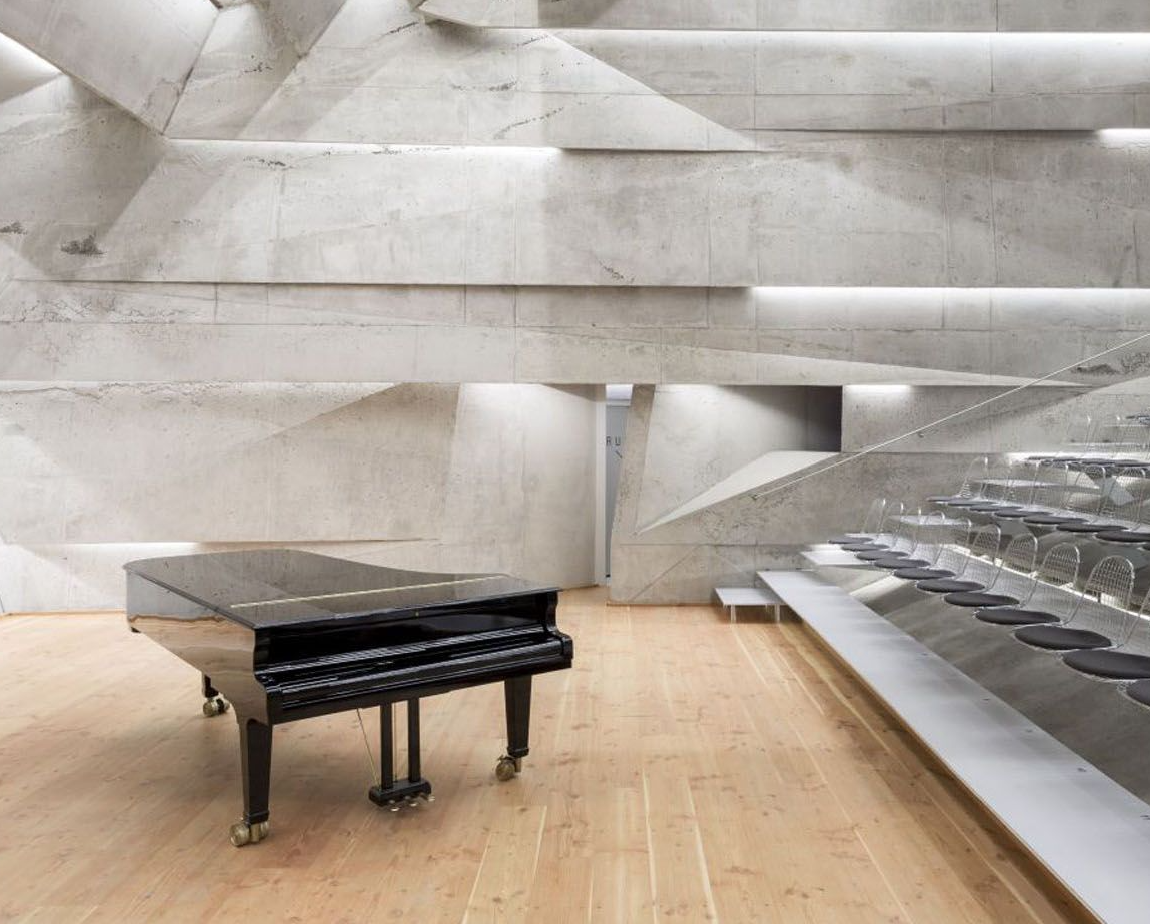
Thomas Small and I are friends, and he's a great authority on music, and I love architecture. We both love architecture, and we were traveling through the Czech Republic, looking at some wonderful monuments, including the National Theater, the Estates Theater, where Mozart premiered Don Giovanni back in the 1790s, and he suggested a book on opera houses and concert halls. And I said, fine, let's limit it to Europe because that's where it all began and where the greatest historical examples are located. Also, some of the most adventurous new theaters. Let's do a history of those two typologies, tracing their origins, exploring how they've been varied over the years in different countries by different architects for different clients, and that was the genesis of the book. And then we did research in most of the European countries, visiting the halls, listening to concerts, talking to directors, music directors, and performers, and gradually getting a sense of how this incredibly rich typology took root, achieved huge popularity, slipped away perhaps in recent decades, or fewer people now going to the opera. But that's okay. It doesn't have to be a mass spectacle. You don't need 30,000 people in a stadium to justify a performance. 200, if they're really dedicated in a small hall, listening intensely to a talented group or soloist, they might change their lives, sitting and enrich their lives, and it was from that combination of music and architecture. Now the two reinforced each other. How a wonderful group would raise the spirits, but only if the sight lines and acoustics were good, and there were a pleasing prospect. You can be in a very dull hall, and somehow the music just doesn't sound as good. Disney Hall would be a perfect example of a building conceived for that one experience of listening to classical music-not conferences, not jazz, not anything else. Just classical music, because it does one thing superbly well. It makes the orchestra sound greater. It makes the orchestra feel greater, no question. The morale boost it gives to the players is huge. The sense of engagement, the feeling the audience is close to the players. Interestingly, that occurred in the very earliest theaters, the court theaters that were built for rulers of small principalities all over Europe. They all competed to have their little opera house, and many of them were musicians themselves. This was a civilized age in which everybody studied music, and out of that grew the grand opera house, and the rather stripped-down opera houses that are being built today. And out of the music room, where Haydn might, you know, play his latest quartet for Princess Tahazy, came a performance space that is tiny and intimate, and the you can step onto the stage and shake the hands of the violinist if you felt so inclined. So all of this variety, all of this heritage, and the way that it's been constantly renewed, generation by generation, and accommodated many different kinds of music, going back to the earliest period, coming up to the very latest composition.
Daniel Safarik 11:33
Right. I mean, one of the things that was striking to me about the book and and the projects that are included, you know, of course, as you mentioned, these were competing monarchs or mini monarchs in many cases, burghers and principles of society in the German-speaking countries and elsewhere in Europe. So they were competing to outdo each other, of course, with the elaborateness of the architecture and decoration. Did you have any sense of how that might have affected the acoustics? Because I know most of these halls underwent significant renovations in terms of the back of house technology, you know, the lighting and the HVAC and all this type of thing. But also, it is. It seems that a number of them went through alterations where the underlying material was changed to improve the acoustics. Do you have a sense that that there was a was there a classical typology that has my my uneducated brain would suggest that a bunch of ornamentation might cause a lot of deflections of sound that might not be ideal for listening.
Michael Webb 12:46
No, actually, what was your finding? Quite the opposite. This is what is so interesting that by chance, because nobody knew what acoustics were, certainly couldn't define them or deal with them in scientific terms, as they can today, but back in the 17th century, when opera began, when the first opera houses were built, some private, some public, some for mass spectacles, some for the entertainment of the ruler of mixture, they all adopted a very similar plan of a horseshoe, and the horseshoe would embrace a stage at the center or a stage at the end. But either way, the the audience, though it was hierarchical, you had you know the rich and the and the best seats and the poor in the gallery at the top, but everybody was almost equally close to the stage, it was in that respect very democratic, and very effective acoustically, because yes, there was a lot of ornament, and that bounced the sound around, so it didn't hit a blank surface and bounce back as an echo. It spread out, diffusing the sound, is a crucial factor, as I understand, in acoustics, and so abstract patterns, rather than putti and angels flying in the air, now serve the same purpose as the decorations of the Baroque era. So, but a lot of it was guesswork. When Charles Garnier designed the Paris Opera, which took a very long time because there was a war in the middle, and you know had to stop work for that, and the emperor disappeared, for whom it had been originally designed, and now it was a republic. Nonetheless, he designed what is one of the most magnificent operas in the world has lousy sound, and he himself admitted that he knew nothing about acoustics. Everything he'd heard about it was contradictory. One said one thing, one another, and he said, "The hell with it! I'm just going to trust my judgment. You know, I'm going to build one." I think should be done, and you know, let's see what how it works. Well, I had a performance of a Handel opera from a pretty good seat last year, and you could only hear a very small part of it because the sound disappeared. The hall was so big, and somehow the sound vanished on its way to me. It was like the sound from a distant planet, but the spectacle was fantastic, and the aura of being in one of the world's great concert halls-you know, a scholar is better, but you know, there's something magic about. We don't have to be a Lloyd Webber fan to love the Paris Opera or care about the Phantom.
Daniel Safarik 15:44
So the real Phantom of the Opera was, in fact, the sound because it was missing. It
Michael Webb 15:49
was the Phantom was exactly
Daniel Safarik 15:53
right. So that's yeah. I mean, of course, we we must recognize that you know the purpose of a lot of these places was to see and be seen, absolutely, and not necessarily. I should
Michael Webb 16:05
intersperse that the poor, poorer classes who occupied the gallery were by far the best audience for opera in the 19th century. They knew their singers. Their singers excelled. They cheered. They demanded an encore. If they didn't, they held rotten vegetables. Gilly, who was considered one of the great tenors of the early 20th century, was booed off the stage at Naples. Never went back. And whether it was just a bad night, maybe had a cold. Who knows? Or maybe the audience was not in a good mood. We don't know, but it was the rich who came purely for a social event. They would arrive late, they would chatter through the performance, they would pause to listen to a favorite soprano, they would then adjourn for dinner or a game of cards or tryst, and the French, who interestingly, before the revolution said boxes are immoral, and it's all dreadful things that go on in boxes, we can have open balconies. So the Grand Theater in Bordeaux, which was completed in 1780, just before the revolution, has all open balconies, no hanky panky. Everybody is on full public view, but the box was designed to showcase first the ruler, of course, and then the more kind of aristocratic members of his entourage, and it was designed in such a way as to show off the occupant rather than to give them the best view of the stage, so all of the old opera houses are in that respect obsolete, but they have other compensating virtues.
Daniel Safarik 17:52
That's fascinating, and I love that fact that, of course, it's the rich people who are misbehaving and interrupting the show, not the hoi polloi. They're there to hear the music, right? This is like the highlight of their year. Yeah, miss the start, miss the end. Indeed, that's phenomenal. So, if as we get into the you know into the 20th century and into the modern era, a different kind of sort of competition takes place. You know, it's not individual principalities, mini monarchs, as I'm calling them, but you know, it's it's it's ideologies, it's communism, it's communism versus capitalism, and you tell the story of Berlin, you know, pretty dramatically, where you've got competing opera houses on both sides of the wall.
Michael Webb 18:38
Well, what is so fascinating about Berlin is it's two faces of the same phenomena. Berlin was devastated, obviously during the war. Had to be rebuilt. The communist, the the DDR, the communist side, basically rebuilt the monuments that they had before the war in traditional style. The state opera on the Unter de Linden, for example, the West Berliners decided that modernism would be their badge. This was very much an American influence thing, you know, subsidizing exhibitions of New York Expressionism, abstract art, contemporary literature, all the subversive modern things that the communists were trying to turn away from or shield their population from. So when the mayor of Berlin, Betty Willy Brandt, inaugurated the Deutsche Opera, the new opera in Berlin, which was purposely built very close to the East Berlin, he said. We don't need pompous display. Now, was he referring to 18th-century display, which is what the Soviet side was doing, or Nazi display? Either way, it was a reaction against the. It was a purification, simplification. So you have this very plain opera, so no decoration, no ornament at all. And I found it a little intimidatingly, I'd say, oppressive the first time I saw it, but going back and looking at it in more detail, I realize it's a very beautiful thing. It's minimal, and it's done in a very intelligent way. It's on a busy street, which is the barge shielded off by a blank wall, but the sides are open and gloss, so they draw the life of the street into the gallery, draw natural light in during matinees and during the day, and everything is very accessible. You don't have to go through endless corridors, up endless staircases. You arrive in a main lobby, you go into the theater, and there it is. And the more recent theaters, like the one in Athens that the Niagara Foundation sponsored, or the Oslo Opera House that Snowhead designed, are again very plain, very accessible, but also include a lot of gathering spaces. Opera is no longer whatever you're told, an elitist start. Yes, there are some rich people who go, and yes, there are expensive tickets. No more expensive, by the way, than hearing Taylor Swift as a distance spec in a stadium. Right. The price is probably less for a box seat in an opera house. But what's more important is the audience is much more committed to the music. It's an over a social spectacle. It's an over excuse to visit your friends and chatter. It's an excuse to book six months ahead, pay quite a lot of money, know something about the opera, and shut up. Turn your cell phone off. Stop, you know, tweeting while you're watching. For three blessed hours, you are severed from all the technological distractions, all of the diversions that we waste our lives on, and you are immersed in something that may have been composed hundreds of years ago and still be vanished. How many other arts can you say that of?
Daniel Safarik 22:30
That's true. Almost, almost a distraction-free environment. I mean, that's the ideal, right? So, in terms of okay, now of course this is a this is a very obvious question, but I'm going to ask it anyway. Which is, do you have a favorite architecturally of all the opera houses that you surveyed, or music venues? You did look at some orchestra halls as well, architecturally, and is it different from the one that is your favorite to hear music in?
Michael Webb 23:00
Well, my favorite opera house would probably have to be the Teatro di San Carlo in Naples. It's one of the oldest public opera houses. It is drop dead gorgeous. The love of music, which was very high in the 18th century when it was built, is still very high. People in Naples get excited by the new productions. They also debate them furiously. I saw Elektra, Strauss's Elektra, done in what looked like a reinforced concrete facade with different levels and people seeing from the different levels and so on, which would not have been my first choice. But the opera house provided the beauty that one might have missed on stage. The seeing was superb. The acoustics were great. It was an event. It was an absolutely extraordinary event. I have to say, much as I admire some of the more recent opera houses, notably the Alvu designed opera house in Essen, none of them quite has the charge, the emotional, Esthetic architectural charge of San Carlo that I would put at the top for concert hall. I picked the Alp Philharmonie in Hamburg, which builds on the idea that Charoon had in Berlin in 1964 with the Berlin Philharmonie, which was the first vineyard plan where blocks of seating were separated and arranged around the stage, so that everywhere the orchestra looks, they see the faces of their audience, and the orchestra and the audience, kind of as it were, press on. Onto the orchestra, and it's a wonderful thing to see a video of a performance in the Balladine Philharmoni, because the back row behind the orchestra feel as though they're the back row of the orchestra. They are so close to the performance. Well, Philharmonie does all of that on a more sophisticated, grander scale. It's a bit steep for me. It's hard climbing up all those stairs, but and the elevators, of course, are totally inadequate. But it is a thrilling experience to see the spectacle of this huge auditorium and everybody coming together, which is why we put it on the cover of the book.
Daniel Safarik 25:45
So you did. Interesting, yes. And actually, that building qualifies as a skyscraper because it's in our database. Yeah, it is. This latest
Michael Webb 25:55
civic icon for Hamburg. Yeah, the city that really didn't have one before. It had some beautiful buildings, but nothing that could be really considered the the civic icon, and now it does. And interestingly, Hertz de Moran worked with a local developer to build their glass tower atop a brick warehouse, which is a kind of symbol of Hamburg as a trading city going back to Hanseatic times, and they built up this tower, which consists of hotel and apartments, restaurants, and so on, wrapped around the concert hall as a kind of shield, isolating it from the sounds of the river traffic, the horns of the ships and so on, isolating it in you know physically, so it doesn't pick up rumbles from the subway underneath. It's like a yolk floating in the middle of an egg, and it is completely isolated. And there are two smaller holes down below, which are much simpler. But there's one grand hall at the very top, surrounded by balconies looking out over the city, you know, space, huge staircases. We meet meet your friends. Doesn't get better than that.
Daniel Safarik 27:16
Phenomenal! I would love to visit some of these.
Michael Webb 27:18
That's why you have to get the book because the book shows you all these, it's essentially a guide to people who are interested in traveling around Europe, listening to concerts, looking at beautiful buildings, and enjoying all the other pleasures that come with European cities. And you know, at a time where tourism is becoming ever more frantic. The idea not only of going to Berlin and Vienna and Paris and Prague, but also little villages that may have a little jam like Bleibach, where Thomas Bauer, the the baritone, grew up in this Bavarian forest village, and decided he wanted his children to experience it. So he bought a farmhouse. He lives in Berlin, Berlin right now. But bought a farmhouse in Blybeck. He commissioned a local architect, Peter Heimel, to design a tiny hall where he and his friends could perform. And it's only 200 seats, and it's basically as austere as it comes. It's a concrete box like a coffin, tilted down a hill, metal bleachers, wire chairs like the Boyer chairs, and 200 people. They produced Dasrango of the first opera of the Ring cycle, with 70 performers on this tiny stage, the audience and the players were like that, coming together. Nothing that Bayreuth could offer could compete with that, and a lot of people said this is so much better than Bayreuth, much more comfortable, a fraction the cost in every way, a revelation. Well, how would you know? Read the book.
Daniel Safarik 29:08
Excellent. Well, that's a that's a ringing a a ringing or a a hush tone endorsement, depending on how you look at it. Michael, I want to thank you so much for spending time with me and inviting me to your home, which is lovely, here in Strathmore Apartments in Los Angeles, Richard Neutra, and the home of Charles and Ray Eames. Fantastic book. It's called "Music and Architecture in Harmony: Opera Houses and Concert Halls of Europe, 1672 to 2022. Michael Webb. Thanks again.
Michael Webb 29:38
Thank you, Daniel.
Daniel Safarik 30:34
So we've heard how architecture and music have been in harmony, and some of the societal and design implications of that. Now we can get a bit into the science and the importance of what we hear and how we hear in public spaces. Later in the same week in L.A. I had the opportunity to interview an old friend of mine, Elizabeth Valmont, whose job at Arup, the global engineering firm, is to engineer great sonic experiences not only in concert halls but in stadiums. She took me to the SoundLab ®, an acoustically isolated room with surround sound speakers and screens that can simulate the sonic qualities of virtually any designed environment. We tested a few scenarios; some recorded better than others. The sophistication of the multi-channel environment confused my poor microphone. It just didn't know which direction to orient itself, there was so much happening. So this has been edited for length and clarity, and it's followed by an interview with Elizabeth. The
Elizabeth Valmont 31:59
Arab Sound Lab is used to simulate spaces that exist or spaces that do not exist. So if we are working with an architect, an owner on a new stadium, concert hall, airport terminal, we could play it back in three Ds to listen to it. The way the tool is built, just very briefly, I'll start with the audio so that Erica could turn on the loudspeakers. You are sitting in a ambisonic audio system that has loudspeakers behind the walls. So there's a ring of loudspeakers at low level, mid level, and of course at high level with four subs. And what that does is support that 3D audio immersive experience by using Ambisonics, right? So Ambisonics is not something proprietary. You could, if you have some a few dollars, you could probably put a rig, similar rig, in your own living room. But this is how we use it here to create that 3d experience. We have sound labs all over the world. At this point in this very abstract map, we have over 25 simulation spaces. Not all of them are sound labs. Some of them are kits that are more mobile, but we do have that presence all over the world, so we could serve our clients all over the world. Started out back in 1999. Our first one was in New York, and so our work started out with mostly the arts and culture world, where we were simulating concert halls, but now since then, circa today, 2026, we are simulating spaces that go beyond the arts and cultural space, from rail to aviation to healthcare. You name it, we are simulating it if an owner has a question that they want answered, and so the tool is helpful, and I think in our consultancy is helpful and is a differentiator because normally we would provide, like any acoustic consultant, a brief of our work with a lot of semantic descriptions and acoustic metrics of reverberation time acoustic privacy, et cetera, et cetera. But in this case, we could step back from that brief and allow you to listen firsthand of what that sounds like, so that you can make your own judgment and make better decisions. Maybe for value engineering, but maybe for the design, if it's worth just a little bit about the room before we start playing sounds and show you what ambisonic sounds like, the room you could you could probably tell from when the moment you walked from the lobby into this space that's a little bit more dead. So we have a very controlled room acoustic, and that's supported because we have this hit and miss sort of checkerboard pattern of diffusion and sound absorption on the ceiling. That same pattern is actually happening at the walls, but behind this acoustically transparent fabric. The acoustically transparent fabric is a little transparent, so you could see. Sometimes I point to the corner when there is. More light, you can kind of see one of those baffled diffusers. They're just white, not black, so it's really trying to be transparent. Walls and this space is a box and box, a classic concert hall style. You want to have like a box and box, so that's why you saw that you or felt that you might have been going up a ramp, because all six sides of this box is detached acoustically from the base building, so there's no transmission in and out in terms of sound isolation. And lastly, background noise, very quiet in here. If I'm quiet, but you feel cool. So HVAC is working, but what we do is bring the noise floor of the HVAC as low as you would expect for a concert hall, like Walt Disney Concert Hall, right? Less than NC 20. It's a very the point is is it shouldn't be you should not hear any noise from the air from the HVAC, right? And you don't so, and that's so that we don't add any coloring to this room, so you're purely hearing what's coming out of the loudspeakers.
Daniel Safarik 36:07
As I mentioned at the beginning of the recording, we did go through about five or six different scenarios in the sound lab, and pretty much none of them were usable. Ironically, except the sound of the New York City subway, which was being tested for the what was then the under design Second Avenue project, and here's a look up from that.
Elizabeth Valmont 36:33
So I'm going to flip over and show you now. Fast forward from culture into the world of rail and how we could use it for things as simple as speech intelligibility.
Elizabeth Valmont 36:44
Arup started the design for Second Avenue Subway in 2001, having recently finished design on the Hong Kong MTR and the London Jubilee Line extension. What we found is that achieving good speech intelligibility in stations does not solely require thinking about the platform design; it requires thinking about the entire signal chain from operator booth through the microphone cabling, all the way to the loudspeaker selection and placement of sound-absorbing finishes. Let's experience how we demonstrated these elements to our client during the design of the Second Avenue subway line in New York City. We begin with a voice alone. A Brooklyn-bound R train is approaching the station now through a microphone. Brooklyn-bound R train is approaching the station in a noisy booth. A Brooklyn-bound R train is approaching the station through public address loudspeakers. A Brooklyn-bound R train is approaching a station in a reverberant, untreated station. Now let's isolate the booth and improve cabling. Our train is approaching the station. Upgrade the microphone response. On the mound, our train is approaching the station. Improve the loudspeaker directivity and layout. A Brooklyn mound of our train is approaching the station. And finally, add sound-absorbing finishes to reduce reverberance.
Daniel Safarik 38:15
Hear the difference? Yes, all of those are more intelligible than any announcement I ever heard on the New York City subway system. Living there for six years between 1998 and 2004.
Elizabeth Valmont 38:28
This would have been. This is a summary of the demonstration. But when we actually did the SoundLab (R) demonstration in New York for the New York MTA, walking them through sort of their pain points, and then giving them the medicine. It was all through a slow workshop, going one by one on even more options than what you just saw there, so that they could understand with the funds available to them, where can I get to to make it great, good, or just to code, right? You know, you got to make it intelligible, and so those are really important layers that then we were able to play back for them, so they can make the best decision, and based on whatever cost or implications or design constraints or architectural constraints they had. So that's another example of just speech intelligibility, right?
Daniel Safarik 39:23
It's a great example. I am here with Elizabeth Valmont. She is the Americas sport leader at Arup, an engineering firm that. Some of you may know she's also an adjunct associate professor at the University of Southern California School of Architecture, and Lizzy, if I may call you that.
Elizabeth Valmont 40:11
Of course, she
Daniel Safarik 40:12
and I go way back. I met her in 2005 when she was trying to teach nuns how to use a hobo, and now we're in a padded room. I'll explain. So the hobo was the honest observer by onset. That's what that actually stood for. It's a device that measures climate in inside of a building, including things like relative humidity, carbon dioxide, light intensity, equipment, etc. I was a budding graduate student in architecture, and you had just graduated, I think, from you were doing postgraduate work, I think, at the time. This was in Florida during a conference, and the nuns in question were actually interested in learning about building science, not hobos. So that was in 2005, if you can believe
Elizabeth Valmont 41:06
it. I was wondering what year that was. Was it 2005? Was it 2004? So thank you for confirming.
Daniel Safarik 41:12
Yeah, it's 21 years ago.
Elizabeth Valmont 41:14
I was at a conference. It was a conference. It was an international conference. Do you remember the title? It was for building science. It
Daniel Safarik 41:22
was the Society of Building Science Educators conference in Orlando, August 2005. I was there because I was part of a summer course in environmental science at University of Oregon, and we have a grant to go teach people about building science, and the the professor in question, Walter Gronsik, was one of the authors of you remember Meeb
Elizabeth Valmont 41:48
legend Meeb mechanical and electrical equipment for buildings.
Daniel Safarik 41:52
That's what it was, Meeb. It was a wily title, and that was one of the big, heavy tomes that you had to carry around, at least at my school, and probably at a lot of others, he and another of my professors were writing a new edition of it, and I was helping edit that. That's what it was. Why were you there?
Elizabeth Valmont 42:10
You had a legendary professor. I also had a legendary professor that was with me there.
Daniel Safarik 42:16
That's right. You had something different. I remember
Elizabeth Valmont 42:18
Professor Mark Schiller.
Daniel Safarik 42:20
Mark Schiller, yes,
Elizabeth Valmont 42:21
from USC now, emeritus professor, and I was visiting there. I was at the conference because I was presenting as a student the work and research we did, Professor Schiller and I, around the glare for the Walt Disney Concert Hall.
Daniel Safarik 42:42
That's right,
Elizabeth Valmont 42:43
and you know, that was the very first time I got an award for a presentation. I ended up when we worked back at the LA Memorial Press. Best student international. Very first thing that I collected. I remember that it was also the last I got an award on a presentation. Was looking, but it definitely gave you some confidence on presenting. And you were
Daniel Safarik 43:08
in Orlando, so you got to. You didn't actually go to Disney Disney World, but you did go to Universal Studios. Because I had never experienced something that was very desirable as a young, but
Elizabeth Valmont 43:21
a young girl from no one's child. The architecture is a bolt drawing. The physics just yeah, it was pretty different. Any sound energy just going to the atmosphere
Daniel Safarik 43:32
based on that friend of El Nino, but that's really a story for the Olympics for a totally different purpose.
Michael Webb 43:37
But yeah, we are definitely still here to talk about building architecture, if you will, that's like you've gone through a couple iterations in terms
Daniel Safarik 43:44
of your professional career. What I would do, as you just heard, hopefully on this recording, we went through the sound lab, which is an acoustical testing
Elizabeth Valmont 43:57
room that is used by your episode. So what we did
Elizabeth Valmont 44:00
was Sonic properties of launch a crowdline study for its clients at Arrow. So you're kind of in the acoustics field still, but also now in
Daniel Safarik 44:08
sports, and there's guidance for I would say provocation from from
Elizabeth Valmont 44:13
USC's Trojan football team, and it actually led us to go measure not just the Iron Memorial Coliseum, but some of the other matches that the Trojan football team were going to play in the pack sensors that around that, but since we have January, so what I was going to play for you is just the existing condition. So here's an example where I've showed you projects like
Speaker 4 44:36
the Storm and Concert Hall, which is showing a demonstrating demonstrating a simulation that doesn't exist day to day, but this one is an existing condition. We take our tools in 3d for capturing the audio in
Elizabeth Valmont 44:50
3d, so we could play. My latest hat, I guess. So we were able to diagnose this existing condition in different areas of entertainment, help them understand what the issue. And so why that happened, and what we can do for the future, supporting our American people. This is just a story about the existing conditions of comparing to different to build our sports business and practice. And so I've been doing a lot of traveling recently. I was engaged in a bit of a client campaign for the World Cup, which was really fun. It brought me to go to four different matches. Very exciting.
Daniel Safarik 45:26
Excellent.
Elizabeth Valmont 45:27
And it was a wonderful observation of sport and community, which is so important when we're talking about host city work. So indeed, I still do. You're right about the overlap. I think about you know acoustics in this field as well because acoustics and sensory experiences are very important in the world of sport as they are in any sort of cultural infrastructure environment. But certainly, my role has brought me to broaden the things I do beyond just technical acoustic work.
Daniel Safarik 46:03
In a previous segment of this episode, we we talked to the author Michael Webb, who wrote a book about the great opera houses and orchestra halls of Europe, both from the 18th century or even earlier up to the present age. The architectural esthetics of those buildings, at least in the early days, was very much about ornamentation and about creating a huge impression, you know, for the mini monarchs. I'm calling them like the burgers of Europe who had built them to impress their constituency and probably other mini monarchs. The question I had sort of asked in a non-technical way was: Did the excessive ornamentation that you would see on those buildings contribute or detract from the overall sound? How would we know? How does it compare to how we design today? You know, using smoother surfaces, acoustical baffles, and all kinds of other technical wizardry. I mean, you've spent some time both in classical concert halls and in contemporary concert halls. Is there a difference, and you know, what is it? Are we doing better today, or is it still pretty much the same principles?
Elizabeth Valmont 47:13
That could be taken two ways, very technically or very subjectively. Firstly, I think about acoustic history and my class. I do talk to my class about the history of concert halls, how they came to pass, and we discuss how the formal science of sound actually was not developed around those times. One of the most famous spaces that I discuss in our class is the Musikvereinsal in Vienna, which is, as you say, one of those spaces that are so ornate. And this particular shoebox-shaped concert hall for symphonic music was purpose-built for just that, and so built and opened around 1870 or something, so definitely well before we had a formal science of of sound for formally acoustics, and it's renowned as one of the best concert halls in the world still to this day, and I think there was, you know, philosophy of design at that time for opulence being functional, and it was part of their identity and culture to have such beautiful, ornate balconies and sculptural figures at the lower level tier, if you're familiar with the Musikverein Sall, it's it's a pretty narrow hall, right? I think it's like within a 40 to 50 feet, maybe 43 feet or something wide, and but it's tall. That's why it has the famous shoebox shape, and so the width, the volume, and all of that ornate detail happening across all those vertical surfaces are all actually very functionally supporting that beautiful sound you hear when you're seated at that low level, right, and the balcony level. Although I will be honest with you, I have not experienced the music for Reinstall, but I love it. I study it, and I will say, just as a side note, I am hoping to tick it off my bucket list to visit it this December. So it's it's in the plans. We'll
Daniel Safarik 49:37
have to come back and do a do a report on that. What
Elizabeth Valmont 49:40
did you think? Yeah, but as it is written and has and has been heavily measured, it has acoustic metrics associated with that architecture. The architecture being, you know, length, width, height, and all that diffusion of of ornate details architecture. Really, they all translate to acoustic acoustic metrics like strength and and and and reverberance and looking at you know all those metrics related to what makes the sound sound enveloping and loud enough, but also have a balance of frequencies with brightness and bass warmth and things like that. So it's very functional. There is intention. There is technical intention to all that detail. I think it is necessary. How does it compare to today? Because we're not seeing those types of halls being built today-they're very modern and modern-looking. What's modern looking, right? We-I don't know. What do you? Clean lines,
Daniel Safarik 50:49
smooth materials, not very many materials, kind of a muted palette.
Elizabeth Valmont 50:53
So just because it's local to me, I'll talk about the Walt Disney Concert Hall. I would consider that a very modern version. Those clean lines happening, yet that hall also has attributes to achieve those same acoustic metrics, so that it is wonderfully sounding. Now, you could be a critic of different concert halls and say that you like one versus another subjectively, but you know the designers and the acoustic consultant behind the Walt Disney Concert Hall had metrics they wanted to achieve, and they've achieved them. And I would say a lot of people love it. I definitely loved going to the Walt Disney Concert Hall, but they didn't achieve it by doing all those details. But yet they did different gestures. So, for instance, all of that convex shaping that you're seeing in the hall, and all of the distance of those shapes and those forms with respect to where the seats are are all very intentional, and all supporting that same experience to have an enveloping and balanced acoustic, I suppose I would say that what you really want to achieve as an acoustic consultant in any concert hall is to have every seat in the house being a good one, right? You know, you don't want to be in the shadows, acoustic shadows, right? So, really, I think that that's sort of the goal, and that's what's achieved across the board.
Daniel Safarik 52:22
Yeah, so it's almost like the science that we have today sometimes confirms the pure instinct of these architects and concert hall designers of the past who didn't really understand how sound would work. They they knew perhaps what had been done previously in previous halls, or they knew what a church sounded like, and they had probably some sense that some materials were more reverberant than others. But really, they were kind of winging it with, you know, the local fortune and angel wings, and all the things that and cherubs and all the things that they were festooning these halls with, I had heard that the horseshoe shape is kind of important, and you don't see that many halls done in in the horseshoe shape these days. But that seemed to be as an overall building shape, regardless of whether or where the ornamentation is placed. That I've heard that that was kind of considered the ideal, and that was a sort of a foundation. Is that is that a fact, or is it not really that uniform in terms of the overall shape?
Elizabeth Valmont 53:32
I think the horseshoe shape is famously shown in opera houses, right? Opera houses like La Scala. Okay. One of the things that you know it depends. I mean, let's look at one and see how it's being used because it's going to need to follow some rules in acoustics, right? That you want to have the balcony fronts, the shaping, the geometries are all going to influence how the reflections behave to get back to the receiver, meaning your ears, right? So there's a lot of successful horseshoe-shaped spaces, but I would want to just add a note that is not acoustic. That what we notice, one of the reasons opera houses, for instance, have that horseshoe shape, is actually quite emotional. It's the effect that they lots of these places want to see each other, right? A lot of the places that have horseshoe shapes want the audience to see other audience members across the way. So when you're having that emotional moment, listening to you know, Cecilia Bartoli singing something gorgeous, right? You get emotional, as I would, right? And you see that emotion. Maybe you're crying. Maybe you're a bit moved by the music, and then you're seeing this virtuous cycle of others being moved by the music because they're seeing. You and actually, that's very intentional too. And I would just want to flip it over to sports for a second,
Daniel Safarik 55:08
as you demonstrated in the sound lab just now.
Elizabeth Valmont 55:11
This is a very similar pattern psychologically that you, where you see acoustics influencing how we behave and creating this, what I would call this virtuous cycle of emotion and behavior, right? So, in in the case of La Scala and the Opera House, which, by the way, for reference, I have also not been to La Scala. I have quite. Thank you for saying I like to visit these. I also need to visit quite a few more in my lifetime, but but I would love love to. I would say in the sports world, you know, one of the things we think about is crowd energy. That's a popular situation. Crowd energy is a is is is being studied in acoustics and something we want to achieve Positively in venues for stadiums and and arenas, and so when you think about the 12th man effect and creating that crowd roar and atmosphere for the fan, it's it is for the fan, but it also is for the for the pitch, right? We want to make sure that there's that 12 man effect for the players to get pumped as well and excited, but the again the architecture influences the acoustics there because if you have a space similar to a coliseum where it's just an open bowl, a lot of that sound energy is going to escape, but if you have a venue, a stadium that has more architecture in it, such as overhangs or even just VIP suites have vertical surfaces, right? Which, when you have noise from the crowd, you are reinforcing those lateral reflections back to the crowd, back to the pitch. This can be seen as a very positive thing, and when you get so excited, you're exciting others. And when you think about Premier League venues, which have a well-known intimate atmosphere, they also have that roof overhang, which is helping that capture the cauldron of sound, if you will, from the crowd, but not just forward-facing reflections again to the pitch, but also lateral ones, right? So it's just so what
Daniel Safarik 57:33
we're saying is basically, if you want to bring the noise
Elizabeth Valmont 57:36
across, you've got to replicate what Arup has done with proper football stadiums in Europe, you know, to bring that to the NFL, to bring
Daniel Safarik 57:44
that kind of intensity, or even one of the things that build those bigger enclosed. Well, it's not necessarily bigger, higher ceilinged stadiums that actually have ceilings with enclosure. They're so insular these days. Reverberate that crowd. At our little screens, and we're listening on our headphones. We're blocking out, you know, whatever's going on in our environment, and it's exciting to hear that we're we're. It seems like there's a resurgence in interest in energizing and perfecting physical space so that we can have better IRL in real life experiences. Would you would you agree with that? At the same time, that there's so many distractions that take us away from our physical environment.
Elizabeth Valmont 58:32
You know, I recently was in a workshop that Arup held for sport with some of our clients and community, some external folks were coming into Arup to talk about different topics related to the future of sport, and what do and one of those is what what does the fan want? What is what do what is the future fan experience? And you're touching on that because with this social media that we live in today, and being insular, and you know, video games being part of that too, especially for younger demographics, I suppose. What is the future? And what I found was in speaking with some of our external friends that came in, they were doing studies around the World Cup, and were doing surveys in fan zones and areas where people were watching sport, and they had an observation they shared with me. Again, I'm not saying this is globally,
Daniel Safarik 59:39
sure,
Elizabeth Valmont 59:39
you know, labeling what fans are saying want today, but it was just an interesting moment where I always believe people are always on their phones and watching sport, but you know, half paying attention because they're part of you know they're just in this digital experience that they want to be in, and maybe even bragging rights. But what what these but what the folks. At the workshop, told me were they rarely saw people on phones unless they were taking a picture of the moment. They were otherwise paying attention to the moment, and I would say, you know, this is kind of a very interesting topic for me about the behavior between cultures. Not to speak for the English, I am not English, and I would say that just from my understanding of Premier League matches, it's very analog. You know, it's a very one-on-one, deep experience. They're in the football match, and they're it's it's it's almost it's personal.
Daniel Safarik 1:00:34
Sometimes it gets real personal. I've
Elizabeth Valmont 1:00:36
heard. Well, there's a whole history there. Clying
Daniel Safarik 1:00:38
fists outside,
Elizabeth Valmont 1:00:40
but but but you know when you're in an American larger stadium, you know I remember when we were looking at the LA Memorial Coliseum before the renovation, and some people commented of how remote they felt. You know they and and again no fault of the of of the fan or the players, that was because the architecture wouldn't ever achieve that intimacy. It's a bowl, right? You can't blame a bowl. It's it was meant for a different purpose. Don't
Daniel Safarik 1:01:10
blame the bowl.
Elizabeth Valmont 1:01:11
Don't blame the bowl. So you know, I agree that the experiences of our future are changing for fans. Are we responding to it? I think we just need to definitely be paying attention to how that's evolving.
Daniel Safarik 1:01:29
For sure. Well, you know, I'm I'm of course contributing to the distraction economy by recording this podcast that people have to get enveloped into. Well, thank you for for explaining all these principles to me. Okay, presumably music halls in spaces meant for sonic consumption are the most obvious customers for this kind of engineering. But what are some projects or building typologies that might surprise people that came out of the sound lab?
Elizabeth Valmont 1:01:58
So, in the sound lab, we Talked about classic spaces. I guess you would call them classic. Of you know, we could simulate the reverberation time in a museum in an atrium. We could simulate the sound of public address systems in a subway. We could simulate, you know, concert halls, right? And what what sort of beautiful cultural venues could sound like at first row, or orchestra level, or at the balcony. But I would say, especially today, given it's the 25th anniversary of 911,
Daniel Safarik 1:02:44
indeed it
Elizabeth Valmont 1:02:44
is. One very esoteric project comes to mind, and that is one project I had the honor of working on, which was the Flight 93 Tower of Voices Memorial.
Daniel Safarik 1:02:58
That's right,
Elizabeth Valmont 1:02:59
where we use the Sound Lab as part of the design process, and you know, for those that are not familiar with it, it's in Pennsylvania, Flight 93. We built a 93-foot concrete tower that held 40 large-scale wind chimes, with the largest being about 10 feet in height, and that was to commemorate the passengers and crew members of that flight. And it was a passion project for me, and of course one of the most technically challenging projects for me because we weren't building quite a building. We were building a memorial and really a piece of art and a piece of legacy, a legacy for all those families. And so each of those chimes Were tuned right. We had a tuning table that was done by Sam Peckman. I'll double check that for you. And we worked with Paul Murdock Architects on that memorial. They had done the original Flight 93 museum there, and of course with the National Park Service, and so that journey led us to use the sound lab to listen to what the chimes would sound like in this very large, open plan, Open plane where the plane crashed. We were listening to the tuning table here in the sound lab. We tested chimes physically, the large scale chimes in our sound lab, testing where the striker should be placed. For instance, in the tube, because we decided to have internal strikers instead of an external striker that you would see like in your back porch or something. There was a journey that Paul Mardok discusses in many social in many articles about how that came to pass too. But just you know to keep it going, I would say, you know, we brought in Paul Murdoch to listen to it as well, and the design team, and it was just a beautiful experience of how we could demonstrate in the sound lab something that wasn't built yet at the time, and to listen to it not just for the beauty of the chimes and the music it created, but also to listen it for in terms of how it influenced the environment, obviously there isn't a whole community, residential community, for instance, nearby. But there are some residences, and sound can travel. And just listening to how the chimes would sound with the overlay of the current environment, so we even took measurements of the ambient conditions in its existing state, and then overlaid the sounds of the chimes over that, and had them listen to it at different points in the journey of the design because they had a main plaza level. But there's also this beautiful meditative walk that Paul Murdoch had as part of the the master plan, and so we listened at different points and just seeing how that would influence the the patron. So we honor them. I honor them every 9/11. This this project is probably going to be in my memory every 9/11 forever. But that one would be one that I would say that not many people would know. We were use the Sound Lab.
Daniel Safarik 1:06:45
Wow! Thank you for sharing that. Yeah, of course, a very resonant day for me too, and I use that word in all the in all of its implications. Yeah, what this really tells me is that you know acoustic design when it's thought about in the budget for a project, which often isn't, is just is not an add-on. It is super integral to the to the narrative you experience, regardless of what the purpose of the architecture is. So keep up the good work. I guess, is what I would say.
Elizabeth Valmont 1:07:22
Well, thank you. It's exciting work, and thank you.
Daniel Safarik 1:07:26
It's Lizzie Valmont, Elizabeth Valmont. She is the America's sport and entertainment leader here at Arup.
Elizabeth Valmont 1:07:34
Thank you, Dan.
Listen On
Also In Season 6
-

131. Chatting with Barbarians
Forgive them, for they know not what they do. We have already passed the point w -
130. Build or Die
In this episode, Unfrozen continues to focus on a topic of intense and contempor -
129. Chain Drain
The AECO (architecture / engineering / construction / operation) supply chain is