


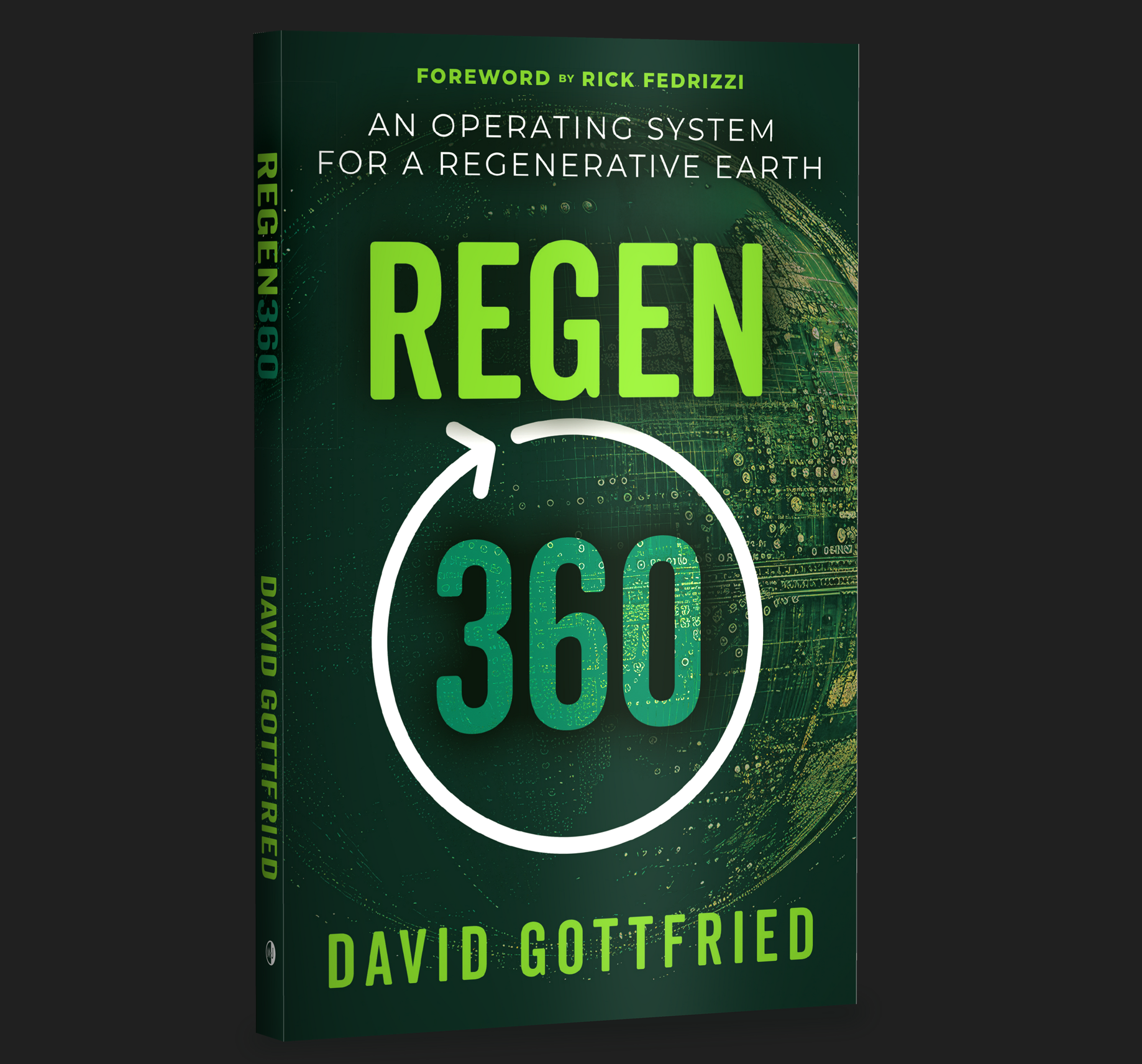
Driven by the same relentless passion that produced the world's most prominent energy-rating system for buildings, LEED, David Gottfried, best-known as the co-founder of the U.S. Green Building Council and founder of the World Green Building Council, has a new project and book: “Regen 360: An Operating System for A Regenerative Earth." The book is equal parts personal memoir, self-reflection, and sustainability manifesto, and David’s jocular, discursive style comes through in both his writing and conversation. He joins Unfrozen to inject a strong dose of hope into the seemingly bleak prospects for the planet.
Show Notes
Intro/Outro: “Getting Better,” by Shed Seven
==
Discussed:
People
- David Gottfried: guest; co-founder of USGBC, founder of WorldGBC (Wikipedia; Regen360)
- Mitch Albom: author of Tuesdays with Morrie, Gottfried's model for the book's dialogue format (Wikipedia)
- Zenobia: third-century queen of Palmyra, namesake of Gottfried's AI thinking partner (Wikipedia)
- Bryan Boyer: co-author of Chain Drain; Taubman College, University of Michigan
- William McDonough: architect and Cradle to Cradle co-author, cited as a blurber of Regen 360 (mcdonough.com)
- Frank Duffy: DEGW co-founder and past RIBA president (Wikipedia; RIBA obituary)
- Art Gensler: founder of Gensler and a Gottfried mentor (Wikipedia)
- Anne Lacaton and Jean-Philippe Vassal: 2021 Pritzker laureates known for "never demolish" transformation (Harvard GSD lecture)
- Patrick Bellew: founder of Atelier Ten; 2023 CTBUH Fazlur R. Khan Lifetime Achievement Award (CVU profile; Atelier Ten announcement)
Books and media
- Regen360: An Operating System for a Regenerative Earth, David Gottfried (regen360.net)
- Explosion Green, David Gottfried's previous book (Wikipedia author page)
- Tuesdays with Morrie, Mitch Albom (Wikipedia)
- Unfrozen 129: Chain Drain, with Bryan Boyer and Greg Lindsay (episode)
- Unfrozen 131: Chatting with Barbarians, with Alexandros Washburn (episode)
- Chain Drain: Why the Built Environment Struggles to Learn and How to Fix It, Boyer and Lindsay, 2026 (chaindrain.netlify.app)
Companies and organizations
- U.S. Green Building Council (USGBC) (usgbc.org)
- World Green Building Council (WorldGBC) (worldgbc.org)
- USGBC California and Arup: California Wildfire Rebuilding Guide after the 2025 Los Angeles fires (Architect magazine; 2026 update)
- Gensler (gensler.com)
- Blue Planet Systems: synthetic limestone aggregate made from captured CO2, a likely match for the carbon-negative concrete sample Gottfried shows (technology)
- Atelier Ten (atelierten.com)
- Rivian R2: cited as an example of published vehicle life cycle data (rivian.com)
- AI tools named: ChatGPT, Claude, Grok, and Gemini
- Council on Vertical Urbanism (CVU), formerly CTBUH (verticalurbanism.org)
Standards, codes, and rating systems
- LEED (usgbc.org/leed)
- LEED v5: carbon assessment prerequisite and whole building life cycle assessment (One Click LCA overview; LEEDuser NC-v5 MRc2)
- BREEAM (breeam.com)
- Green Star, Green Building Council of Australia (gbca.org.au)
- WELL Building Standard (wellcertified.com)
- Environmental Product Declarations (EPDs) and life cycle assessment (LCA)
- Paris Agreement and COP climate conferences (UNFCCC)
Policy and finance
- PACE financing (Property Assessed Clean Energy) (U.S. Department of Energy)
- Nevada Green Building Tax Abatement and CityCenter, Las Vegas (state project list; Las Vegas Sun)
- Arlington County, Virginia, Green Building Incentive Policy: bonus density (FAR) for LEED (Arlington County)
- San Francisco priority permitting for LEED Gold (SF Environment)
- CTBUH 2023 International Conference, Singapore and Kuala Lumpur, Humanizing High Density (see Atelier Ten announcement above)
Show Transcript
Greg Lindsay [00:30]
Hello and welcome to Unfrozen, Episode 133, Regen 360. I'm your co-host, Greg Lindsay.
Dan Safarik [00:37]
And I'm Dan Safarik, and our great guest today is David Gottfried. He is the co-founder of the U.S. Green Building Council and founder of the World Green Building Council, an organization that now spans 85 countries. You may know the Green Building Council as the organization that spurred LEED, that's Leadership in Energy and Environmental Design, a kind of byword for the environmental credentials of buildings and individuals who practice environmental sustainable practices. And, well, David is not a guy who rests on his laurels. He has written a book, one of many actually, but the most recent one we're here to talk about is Regen 360. David, welcome.
David Gottfried [01:22]
Hey, great to be here with you guys. I look forward to a great conversation.
Dan Safarik [01:27]
Well, we are thrilled to have you. This is actually part of a broader media empire, shall we call it? You've got the Regen 360 podcast. You have also written a previous book called Explosion Green. There's several other books with the word green in them. You're kind of known worldwide as a green guy. You know, I have to just wonder, to start things off, you know, this book is, it's a combination of both, it feels like a manifesto, a proposal about policy, and a kind of personal self-help book all in one. And it's pretty extraordinary to see those things combined and actually be successful. It's been really, really enjoyable to read. There's so much in here. What inspired you to write this book after all is said and done? You've already done quite a bit for the planet and obviously the evidence is that the planet hasn't answered the call completely. So maybe there's still work to be done.
David Gottfried [02:36]
Yeah, there's a lot of work to be done, Dan. Honestly, after the third book, Explosion Green, that was, it's 13 years ago. I needed to do 13 years of living and watching and growing up and some personal evolution. And the green building movement kept growing and growing well beyond anybody's dreams. There's no way we thought LEED would be in 194 countries. I think there's only 200 on earth. And if you add up all the LEED certifications and other green building rating systems on earth, I think it's more than a trillion dollars. That's real money. Big countries are in the game. The GBCs, the green building councils, have 50,000 membership organizations representing millions and millions of professionals. One organization might be Google or Walmart and Microsoft and Gensler Architects. So I'm very proud of that. And yes, I could just get hugs at conferences, do speeches, chase a stupid white ball that often doesn't go straight and keep fly fishing, which I love.
But it's not enough. And I kept staring at the slope of climate change and all these great efforts and green building, other super environmental initiatives all over earth, there could be a thousand of them, working on lifecycle assessment and EPDs, environmental product declarations and corporate CSR, corporate social responsibility. It's everywhere. All these big publicly listed firms have a department and they're doing great. They're moving the company, they're goal setting, they're recycling, they're using solar renewable power, they're looking at embodied carbon. But that slope didn't change. Looks like this. It would have been this. And I'm an engineer.
Dan Safarik [05:05]
For listeners, he just went from 45 degrees to 90. We're an audio only podcast, steadfast and true.
David Gottfried [05:11]
Well, I'm a video guy, but I'm a writer. So I'll use my words to describe what things that Dan did. Thank you. But we're not there. We have initiatives all over the place. We're turning the big ship, but it's only a few degrees. We're missing the Paris agreements these countries agreed to. Ours got out the pencil and the eraser and erased our signature, a little sad. And sometimes I think, yeah, we're doing incredible, but we're greening the big aircraft carrier with solar panels on it and wind batteries, little EVs running around on the huge ship. And that ship is headed at the melting iceberg. And it's sitting on a rising ocean and it's getting hot and acidic. The fish are dying, the coral reefs are dying, and the humans are still dropping bombs on each other's heads.
So yes, Dan, there's more work to be done here. And so David rolled up his sleeves, his engineer brain. He's still a dreamer. AI came out. We could have, we could talk further about those conversations. And I went way outside of my comfort zone, a green building. And what do I do? I invent an operating system 2.0 for earth because 1.0 is broken and it bothers me.
Greg Lindsay [06:47]
Yeah, David, as a place to jump off from there, could you unpack Regen 360? Because you've got, you do have an operating system, the Regen OS. There's sort of 15 algorithms that seem to comprise it if I understand it. And then you also have the acronym of HOPE there for Health On Planet Earth. So how is the, how is the manifesto all fit together here in terms of what you've built as a new credo?
David Gottfried [07:08]
Yeah. And don't forget the soul worth score we have to talk about, but you nailed it and it's a little too much. Things always seem simple to me. And sometimes I did try to make it not too complicated. The original manuscript was double in size. And my editor said, no one can comprehend all of that. And to me, it just seemed clear. But this book came about through ChatGPT. Not that chat wrote it, but I had chats with ChatGPT on my dog walks with Juno, the labradoodle who's right here about a foot from me. And did you hear your name? Yeah, she's looking at me and I do these morning dog walks slow through the neighborhood in nature and I learned that ChatGPT had this feature where you could talk and it would transcribe immediately and then it would reply and I started to save these dialogues we were having.
There's a beautiful little book, Mitch Albom, called Tuesdays with Morrie and he would go every Tuesday, have lunch with this older guy and he wrote a book on their conversations and I started to have these great conversations with my AI agent that became known as Zenobia because I wanted to talk to the divine feminine and Zenobia is a mythic queen. So me and the queen had these extensive volleys like tennis. I'd hit it over and say, why don't we treat Earth as home? What's wrong with our brain? And we'd save all that download and Zenobia would say that, I'd save that, and I say, yeah, but you missed this. Well, yeah, but here and here's history and it say, yeah, but that isn't how the brain works and it ended up in 200 topics of dialogues and these volleys became nuggets and the nuggets became 2,600 pages.
And then it took getting COVID for 10 days of bliss because I didn't go out to read 2,600 pages, pull out the Excel spreadsheet as the engineer, write the topics down on the left side, the page numbers on the top, and it ended up in 53 topics that got combined, deleted, synthesized into 15 Earth codes. And each code, very simple equations, got a chapter. And if you run them in Claude or Grok or whatever, it creates V 2.0 of a regenerative Earth and we got it wrong. And but I, instead of making it technical and boring and footnotes and bibliographies, I like to teach through story. It's not all stories, not just a memoir. It's a memoir teaching a framework.
Dan Safarik [10:37]
I mean, I do think one of the most striking things about the book is how personal it is and the way that you're kind of relaying these personal stories into these globe spanning issues where it's like the sheer amount of stuff that you're throwing at us, particularly as we get into like chapter 15, where it's kind of like, you know, we're going to restructure society. We're like this, you know, we're basically going to make everything engineered toward achieving HOPE, Health On Planet Earth. Anything that doesn't achieve that is garbage or throwing it out. And of course, as you're reading this, you're like, yeah, all sounds great. All sounds great. Where do we start? And then you you anticipate that question. You start answering it and you bring in the stuff that you were talking about earlier, where it's kind of like, okay, now I see the point.
I was a little worried about you, David, when I first started reading this because I thought you would fall in love with an AI. And that's what this is all going to be about. But the way that you explain how to use it, it doesn't answer all my questions about what about how we should be skeptical of AI and what it's designed to do. And every day we hear a new horrific story about how it's increasing the rate with which we do all the terrible things we do to the planet. And you're saying, no, it can be re-engineered to do the opposite. And I'm just curious how all those things merge together, you know, in your mind and how somebody who's sitting on the receiving end of this might undertake a similar exercise without getting totally derailed or sent into the depths of, you know, social media hell, which is where we're naturally inclined to go.
I think if we let AI and the algorithms and just the amount of information that's out there do their thing because they're engineered for a system that does that thing. I don't know if that was really a question, but that's my observation. I was kind of, where is he taking us? You know, that was kind of what I was reading through this.
David Gottfried [12:37]
Oh, really? Reading all of it? Or did you stop worrying about David somewhere along the journey of reading, Dan?
Dan Safarik [12:45]
I stopped worrying when I sort of got into the running the code part because then I sort of saw how you hope to bring it together. But I'd like you to share with the audience who may not have had the benefit of reading it yet how we get out of, because it's one thing to say, these are all the principles that society should adopt. And then how as an individual might you start addressing those? And then how does that make its way into policy? I think those are the central questions that I have.
David Gottfried [13:14]
I don't know if I fell in love with AI. I do love technology.
Greg Lindsay [13:20]
We all do.
David Gottfried [13:22]
And the early versions of AI and ChatGPT were too supportive and made me think I was like number one at everything on earth. And I'm not that great at golf. But I created prompts and preferences called truth protocols to guide its words. No bullshit, no cheerleading. Don't tell me anything you can't back up with data. Push back on me. Tell me what I forgot and make it better. Don't BS and so forth. Speak the truth and push back and I'm going to push back on you. And every time I push back, I'd say, please learn and don't do that again. And the newer agents are better, a lot better. Each iteration is mind blowing. It's about every 10 days. But AI is a huge topic. It is Chapter 15. And I write in the code: if AI is a partner, then it must serve capital HOPE, Health On Planet Earth.
Maybe AI is neutral. It could be good or bad. And you can take it where you want. And they need boundaries. They need governance on it. Policies, regulation will come. If it's, hey, how do I make a bomb? How do I put a bomb on my drone? How do I crash my drone into this? How do I make a gun out of plastic and 3D printing at home? I don't know how many of those it'll do. I haven't asked it any of those questions. But a creative mind could keep going down the dark, the dark tunnel. But you could say, I'm going to buy a car. What are the greenest cars? Oh, you think electric cars are good. What are the best alternatives? Well, I've heard electric cars are not that green. Could we have that conversation?
Oh, how much CO2 actually goes into these? What is the source of my grid? Are those electrons that go into the car green? Oh, I live in Texas and we have coal. So maybe it isn't so good, you need to adjust, versus British Columbia where we have wind and, oh, you talk about life cycle assessment, what is that? Tell me how that's coming. Can I get the data for the new Rivian R2 life cycle impact? Oh, it's on their site. They have a report and an annual report. Gosh, you could keep, and you can't easily do that research. Is that research that gives you accurate? Maybe, maybe not. Give me the footnotes, give me the citations, give me the credibility. Let me put it in ChatGPT, Claude, Grok, and Gemini. And I'll put ChatGPT's answer into Claude, and I do that, I'm starting to have fun.
Hey, Claude, ChatGPT said this. But there's also that monstrous footprint of AI. There's an elephant in the room if you're green. The energy's 2% of global warming, 2% of carbon headed to 8%, or not carbon, but it's associated with electricity consumption and growth. And the cloud for David is just what I gave you. What's the CO2 footprint of those 10 questions? And the generative thinking it needs and to keep building and learning, and those monstrous energy consuming data centers sprawling into the trillions sit on a concrete foundation which has Portland cement, which is 8% of global warming. They have steel for the racks, another 8%.
Dan Safarik [17:48]
You could easily work yourself into paralysis with these facts, is what I'm hearing, right? And so, how do you shake loose of that, whether you're talking about the implications of using AI, energy, or otherwise, plus just the endless cavalcade of depressing news that comes out of, if you care about the environment, if you care about the built environment. I think that's what I'm interested in really getting to.
David Gottfried [18:18]
Yeah, it can help you with your technical analysis. It can help you with life cycle assessment data. But I did a podcast called AI for Good. I'll just read you a few of the headlines. I fed my entire book into AI. It said, pull out the AI for Good topics. And it gave me 10 quick topics I had touched on in the book. Number one, it can be a thinking partner, not a tool, but to a level no human can do. The humans I know generally like to sleep. If it's a psychiatrist or therapist, your 50 minutes are up, I'll see you in a week or in a month, here's my bill. And they say goodbye. The AI never says, 50 minutes are up, David, here's my bill. It gives you a bill, but it's not that much compared to the psychiatrist's 395 for 50 minutes.
And it's on and on and on. It doesn't say, dude, it's 3 a.m. You should be sleeping. I'm not gonna answer you. Although Claude is a little pissy and it pushes back and says, I've told you this six times in a row and you didn't answer it. And you told me your throat hurt. You can hear my throat a little bit and you're not resting. And why aren't you taking care of yourself? You're incessantly pushing me to spend more electricity and create more CO2, dude, rest. But the other thing is we have a hot amygdala. We have a problem in our survival wiring as humans. That survival wiring that said, hey, that tiger's coming at me and I'm freezing and hungry and I don't know where to sleep. I'm in trouble. Alert, alert, alert. Now when the car cuts me off, I wanna take my horn on my Tesla and make them into guided missiles and kill the guy.
I'm an alpha male. I'm a green guy who likes to breathe and meditation and nature and wants to improve himself. And you cut me off, I'm pissed and wanna kill you. Why is that? And Grok, which doesn't do it yet, is in the Tesla, but should say, dude, the second I honk the horn, or it could be linked to my Garmin and sees my resting heart rate went up and my cortisol is like, ah. And now we're hot, red amygdala and Mr. Prefrontal Cortex has taken a nap and Grok should say, David, slow down, breathe. Four breaths in, hold it. Four breaths out. Now we're shifting from hot amygdala to parasympathetic system and we're going from sympathetic to parasympathetic and Prefrontal Cortex is saying, this isn't a threat. This is an opportunity. My brother calls it your Bodhisattva, to slow down, to breathe.
So there's a lot we can do. I have a full equation which measures inputs and waste. I need help with the inputs and waste. I need help to know what I've forgotten. And I exhaust all my friends.
Dan Safarik [21:57]
What I'm hearing is that you're very much pro-technology. You're pro-capitalism and the capitalism needs accountability and constraint. There's a way to wire these things together with our natural instincts. And I'm putting that in scare quotes here because you're talking about survival instincts that get triggered seemingly unnecessarily in a lot of cases because of the amount of stimuli that we have in our environments. And so we have to have, we have to develop practices not only for ourselves, but also for the technology that we use so that we don't overreact and start doing things that are damaging, extractive, et cetera. That's sort of what I'm getting from this. Okay, so if I'm a policymaker and I'm reading this, let's say I'm one step up from an individual trying to practice self-care, which is not unimportant, especially in today's environment.
Let's say I'm a policymaker one step up from this and I wanna use Regen 360 to kind of kickstart improvements in policy. Where do I, what do I take from it? Which code should I run?
David Gottfried [23:09]
First off, they're gonna read it. They're gonna hear the stories. They're gonna think, this is a memoir. I don't wanna read this, screw it. And why is this guy so vulnerable telling me so much shit I don't wanna know? This is a green building guy. But you know what? They missed it. They went too fast. They missed it. Read it again and get to the back. Chapter 18, run the code on yourself. Chapter 17, I ran the code and tell you the world we're gonna get. So let's slow down. So now we'll do more of the workshop approach. Code one: if it destroys life, then it is false. Oh, that's so nice. It's sweet and simple. I'll put it on a magnet and put it on my refrigerator. But it doesn't apply to me. You're wrong.
So look at your life. Okay. Your body, soul, mind, spirit. Go to work. Maybe do something. Make product services. You have a family, maybe, probably. Your friends. What's false? Well, what'd you eat for dinner? I don't know. That's a lot of sugar to me. That's a lot of salt. Did you look at your macronutrients? Do you have plants in your diet? A little too much caffeine there. Do you know what it's doing to your cortisol? Oh, you're drinking a bit. Have you measured it? Do you see what it does? Your resting heart rate, your heart rate variability, your resting pulse in the morning. Do you know what your liver's doing? Are you a little hot after that IPA that's great on the hot Friday? Maybe your diet's false. Maybe you don't understand macronutrients.
Maybe your carbs are too high. Oh, you're a cyclist. Do you understand how to fuel it? Do you understand? Okay, let's look at your body. Are you stretching? Are you breathing? Are you doing yoga? Are you overtraining? That's just a body, but maybe some things are false there. Do you know that conversation you had last night with your 13 year old and you pissed her off and you're a little harsh and she ran upstairs and slammed the door and you thought you were right and you didn't go up and you said, let her stew in it a little bit. Well, dude, maybe you hurt her. It's not relevant whether she was, you were right or wrong. You hurt your little daughter, most important thing in your life and you're creating some scars and some distance.
Get off your goddamn butt and go up there and repair. You knock on the door and she says, go away. You know what you say? Daddy loves you. You repair. Your ego got in the way and you're hurting this beautiful, precious thing and you haven't learned how to say, I'm sorry. Can we do better? That relationship was false. Oh, you drove to work. What'd you drive? Oh, I love that SUV at 15 miles a gallon. Dude, no, climate change. Get out of it. What'd you do at work? I worked on this thing we make, this product, this widget. Well, did you do a life cycle assessment on the widget? What's that? How much carbon do you put out? What's that? What's the grid like in terms of the CO2? Do you have solar on your building network?
Do you, what's the air quality like in work? I don't know. It's the newish building. Oh, did you forget to take lunch? Did you have three caffeine because you keep yawning and you stayed up too late gaming? Oh, is that false? Oh, I don't know. Oh, what's your plan L in life? What? I have a plan A, make a shitload of money and spend it, buy a lot of shit I don't need and then get big titles and then I'll donate money after I'm rich. Oh, you have a plan B? Oh yeah, if this job doesn't work, I'm going to start my own business. Oh great. What's your plan L? I don't know. What's that? Oh, it's a legacy plan. Oh, did you remember to plant some seeds that when you're dead, they grow and create a forest of trees that pulls CO2 out of the air, kicks out fresh oxygen, is more than just you and your net worth and your self worth.
Did you ever think about others beyond your life? What's your death score? What? You mean who comes? The eulogies? No, what was the impact of your breathing and consuming all these materials and taking space on earth? What? Yeah, what's the net good you did? Well, I gave to my church. I recycle. Well, what was your lifetime carbon impact? What are all those things when you're dead that are going to keep making earth better, to regenerate the ecosystems? What? That's just code one. I haven't even started on two.
Dan Safarik [28:52]
Well, there's a great, individual decisions matter, is what we're hearing.
Greg Lindsay [28:59]
Yeah, well, then this is where we get back to some of the systemic, and bring it back to, I mean, literally, literally concrete. Cement, of course, is like the number two most produced substance on earth after water. And so, I mean, just listening to the first code, David, and that in life, like, yeah, where'd you come back on the practice and ethics of building? So devoted listeners know that back in episode 129, we talked with Bryan Boyer at Michigan about the report that he and I wrote about Chain Drain and futures of the built environment. And David, I can send it to you later, but one of the scenarios we imagined is sort of almost what you'd call a degrowth scenario, basically, sort of this question of we mine the built environment for what we already have and focus on that sort of circularity.
I saw, you know, McDonough, of course, blurbed your book. I'm curious, like, where, yeah, like, you know, where do you end up, having led the Green Building Council, having helped create LEED? Where do you end up on this notion of, like, should we even be building at all? Like, you know, I mean, Gensler, you mentioned Gensler earlier, like a friend of mine was their ESG consultant. And, you know, I think she got mounting cognitive dissonance at the idea that Gensler could ever be truly net zero. How can you be net zero if you're in the business of producing the built environment? So where do you see the field going, and practitioners going to live with these principles and ask themselves these questions when, as Frank Duffy said so many years ago, like, architects are like slaves at the mill just mindlessly producing buildings. Like, how do we bring that back together as a profession and as a sector?
David Gottfried [30:22]
Good for you. Love the turning of our little ship here, Greg. You're turning us around. Well, Art Gensler is one of my mentors. He used to call me to his office and say, Gottfried, get over here. He'd pound on this table and he's an imposing guy. He passed away, unfortunately. But that LEED, I like it. But Pareto's law, 80/20, you guys are 100% perfect and purist and blind reviewers, and so what if they cheat, and if they're cheating, that's success, you're still getting the 80% doing good. I miss him. Love Art. You know, here's a little demonstration piece of broken concrete, some white rocks. Those white rocks are calcium carbonate limestone. They're made with captured CO2 out of a flue gas stack before it's emitted, and then the calcium carbonate, coral, is compressed in an isostatic press and it's carbon negative.
This is carbon negative concrete. It's not commercial yet, but it's possible. This is what the oceans do to create the lithosphere. The carbon on Earth is in the lithosphere. We can learn from it and it's strong, compressive strength. We can wake up. Here's a little piece of prefab concrete we can make more efficient. You can put lots of slag in it. And the building industry is waking up. It's turning the ship. We're using solar or wind, batteries to load shift, superinsulating, better glazing, better sensors, better controls, better mechanical, better refrigerants, materials that don't off-gas VOCs. We're getting there. Resiliency. We're slow. They're burning down. The flooding, maybe we'll learn. There's home hardening. I helped work on a home hardening guide with Arup engineers and USGBC California for the people in the Palisades fire. They're getting there.
There's LEED version 5.0 that came out. It's got whole building lifecycle assessment, more credits for embodied carbon. Embodied carbon is that first cost of carbon to make the concrete or the steel. The cement has so much energy because you're burning it and it's releasing CO2, the limestone, using high temperatures, but you can do it at low temperature like coral and coral reefs. You can use non-carbon, magnesium. We're getting there, not fast enough. New buildings are the darlings of green. Existing buildings are small, old, and carbon hogs. I call them clunker buildings. They consume lots of water and energy and no measurements. They're 100,000 square feet or smaller and they're inherited because the dad who bought 12 of these died and the kids got them and they just want their money and cash flow to buy stuff.
And they don't want to super insulate them. They don't want to change the single pane windows. They're leaking. They don't want to put on solar, but they could do a PPA and lease it, and they're fighting over who owns it and when we can sell it. And there's tons of them. There's millions of those clunkers. If I were running the utilities, they know the clunker buildings, but we got to go into the clunker buildings, back to governance, and give them carrots. Hey, if you do this, I'll give you the money. We have PACE. It's really great. The PACE program, if you go super energy efficient, you can get PACE loans, PACE products that they've sourced at volume discounts, and they secure the loan to your real estate tax bill, which is a phenomenal invention, instead of personal credit.
And it created a whole world for energy efficiency, so we can expand PACE into embodied carbon, into resiliency, into health, into life. It's a good model. We have tax credits in Nevada. The CityCenter project, 20 billion dollars, went LEED Silver because they got an abatement of 10 years of real estate taxes. And they're not green people. They wanted smoking in the building. But they like the money. In Arlington, Virginia, you could build a bigger building, more FAR, floor area ratio, if you went LEED. In San Francisco, LEED Gold, front of the line for the building permit. If you have a hundred million dollar site, take six months off getting the building permit. Six percent interest rate. You could run those numbers. It's a lot of money you'd save. Just go LEED Gold.
Dan Safarik [35:44]
With respect to the to build or not to build question, or new or renew, what do you think of the work of practitioners like Lacaton & Vassal? That comes up a lot. They basically have a prohibition against doing new, build new buildings, that they're all renovations and they're all very architecturally significant and appreciated by the community. Your manifesto has a lot of things in it, but that's not one of them. You don't stop short of that. It sounds like there are enough incentives out there that if we change the means of production in terms of how sustainable they are, combined with going back and renovating the clunkers, we could start making some progress in that 39 to 40 percent of CO2 emissions that the built environment contributes to atmospheric carbon.
David Gottfried [36:38]
I'm pro-capitalism. I love the model. I love making money. I like building businesses. This is not a de-growth book. It's just saying that capitalism got it wrong. We got it wrong as government and society. Capitalists just want to make their money. Do you want to make a billion dollars? Sure. Do you want to make a billion dollars? Do you care how I make it? Yeah, I don't really want to kill people. I don't want to get arrested. I don't want to have jail time. What if I could show you how to make a billion dollars and do good? Is that interesting? Yeah, yeah, yeah. What if I get you a billion dollars and a billion people want to hug you? Do you want that? And you're celebrated as not just a rich dude in Forbes, but a hero of the planet.
Do you want that? And your kids might even like you. Yeah, yeah, yeah, yeah. Well, let me show you how to do it. And then use carrots and sticks with regulation, building codes, policies, tax credits, FAR grants, get creative. There's over a hundred to 200 incentives that ended up in green building at the local government, state, sometimes feds, that were very creative. And they're trying to steer the ship in the right direction away from the melting iceberg. We just have to have that on steroids. It has to be embedded in everything. You know, if it's not net zero, you go to jail. If you don't move into the positive in 10 years, you go to jail. If you make it 100% positive where you're putting off double the energy use into the grid, I'll give you a shit ton of money.
And would you like that? If you go way beyond LEED Platinum, you don't have to pay real estate taxes for 10 years and it's worth $10 million. Are you interested? If you regenerate that site to where it was in the 1600s and replace the 30 nature based services, I'll let you triple the size of the building. Because that building is a beacon for regeneration of the water, the soil, the birds, the trees, the sun. Go, go, go.
Dan Safarik [39:12]
Okay, so the tools are there. We have a huge array of tools. It's just a question of whether we're willing to deploy them at scale. So a lot of the incentives that you described, they could happen at the localized level. And I'm thinking now just within the envelope of the US. I mean, Europe has its own set of regulations and emerging economies have their own set of concerns, etc. Let's just take the US as an example. Do we need to wait out this administration before any of this can accelerate to scale? Because you're talking to someone as if they're an ethical person when you're making all these propositions, even though, yeah, they're capitalists, they want to make money, they're developers, whatever. If the market... And then, theoretically, the regulatory environment will respond, but only if the regulatory environment actually believes in science.
David Gottfried [40:09]
Well, there is that problem. If you don't believe in truth and science, I don't know, I want to get it. I do martial arts and I want to do a little sparring, but that's hard. If you don't believe in truth and science and ethics, that's hard because then you don't believe in the laws that we created. And then you don't believe in civilization and society and it falls apart as we're seeing, which is sad. It's the saddest thing I've seen in my life. But you don't wait. Hell no. You quadruple the efforts. The states like California are going at it and doubling up, tripling up. The corporate leaders just stop using those words that get them in trouble, but they do it under different labels. But why, you want to make a crappy product because of the administration?
No, you want no waste. You want it efficient and you want to make money and you can do that. If you can cut your energy bill in half, your water bill in half, you save money. What real estate developer doesn't want lower expenses so their net operating income is higher? If the building's healthier, it has more daylighting and you're smart and you know how to market, you get faster lease up of the building. Maybe you get higher rent. You get the tenant instead of the other building. You keep your tenant because there aren't hot and cold complaints. When you go to sell it, your capitalization rate, that's the cap rate, interest rate divided into the NOI, is lower, which creates a higher market cap. If you're a high quality firm, a Google, an Apple, a Microsoft, a Disney, your price earnings ratio is higher because of these types of regenerative advanced thinking.
You track, you goal set, you monitor, you report, and you get the customers like me who have bought every damn product you have. We're loyal. I don't care if it's more. I want it.
Greg Lindsay [42:27]
But then I guess, David, would you agree then that the fundamental problem with the built environment sector is that it doesn't measure and track that? That was exactly the hypothesis of our Chain Drain paper, that unlike manufacturing or software or AI, it doesn't learn from itself. The projects are so big, the timescales are so long, there's so many pieces in the chain that it just never ever has a chance to really learn from itself. And I'm curious how you see that play, of course, into Regen as well, too. There's very little virtuous cycle. Stuff just disappears. We forget things. Projects close out, that kind of thing. Yeah. How do we fix that?
David Gottfried [42:57]
I don't fully agree. It is learning from itself. There it is turning. I've seen thousands of examples in the last 20 years. It's a slow industry to change because it's more dispersed, distributed. It's harder to regulate. You have the developer, he or she hires the general contractor, who hires 52 subcontractors, who buy from disparate manufacturers and their specs and plans. But it's hard. And maybe that building has 20,000 products in it. And you want the EPD, the Environmental Product Declaration, for 20,000 materials. And it's hard. And then some of them don't report. Not all the carpets are doing it. The bigger ones are. And they're publishing. And then you need the consultant to run it all and steer it. But it's happening. We have hundreds of thousands of certified buildings on Earth. We have hundreds of thousands of accredited professionals, whether it's LEED or BREEAM or Green Star or WELL for health.
We have the schools teaching it. We have codes representing it. We have tax credits referring to it. It's happening in buildings more than anywhere on Earth. And the other industries are creating councils like we had the Green Building Council. They're creating the Restaurant Council, the Green Restaurant Council, the Green Hotel Council, the Green Food Council. It's happening. Not fast enough. The problem is urgency. The problem is pulling it into the regulations and the incentives fast. We go to COP and we talk, talk, talk, talk. And we pledge, pledge, pledge. And we photograph, photograph, photograph. But the slope doesn't change. And so we're just not waking up in time. Technology's evolving, but humans are slow to evolve. And there's a big gap between technology evolution and humans. They're not flat, but they're slow. And we need 52 lifetimes of coming back to get to where we need to be tomorrow.
And it's not happening. We're not waking. And a lot of it is the brain and the survival wiring. That's why I have a chapter on it in the book. It's like, what's wrong with us? Can we rewire through plasticity, experience, wisdom, knowledge, gurus, mentors, codes, standards, governance, and AI to be a governor of the hot amygdala, to move us to the prefrontal cortex before we extinguish ourselves?
Dan Safarik [45:55]
Well, that is an urgent message indeed. And I've got a feeling you're resting up to go on the road and take this virtually and physically to as many people as you can to reiterate that urgency. Because, by the way, thank you for referencing the Council on Tall Buildings and Urban Habitat conference, where you felt godlike after having given a presentation. Appreciate the plug there. And that was an awesome presentation. That's probably why we're talking today.
David Gottfried [46:25]
Really? How did you see that?
Dan Safarik [46:27]
I was in the audience.
David Gottfried [46:28]
Oh, I didn't know that.
Dan Safarik [46:31]
I work for them. That's my day job. I'm the director of research and thought leadership for the Council on Vertical Urbanism, which was previously the Council on Tall Buildings.
David Gottfried [46:42]
But I was, now I remember how we met. I'm sorry. I've done 50 podcasts, and now I know it's Javier to you. Now I remember.
Dan Safarik [46:50]
Yeah. I'm sorry, because that just tells me that you're being relentless. You're living your truth. You're following your own advice. You are out there. I know you've mentioned in the book you do the monster bike rides and all this stuff and the kung fu and all the practices. You got to do something like that in order to be agile enough to get out there and get this message out. But it seems like that's the kind of urgency. It's just a question of talking to everyone who will listen. I guess that's what it boils down to. And we shouldn't get dismayed, I guess, is the message, by the fact that we have some big non-listeners in charge right now. We still have to go to the listeners, and there's a lot of them out there, and they run the clunkers, but they also run big corporations, and not to lose hope. I hope that that's the takeaway from that.
David Gottfried [47:43]
Yeah, no. Thank you. The goal is to have hope, little hope for hope, capital HOPE, Health On Planet Earth, and hope that humans can evolve, that they can accelerate their own evolution for good, and that AI can be harnessed to accelerate that, not cause more damage and harm. Hope that we can wake up. But in that room, Dan, in Singapore, before I spoke, there were two other speakers and they got awards, I remember, and one was from Singapore and he had created the nature plan for all the buildings and parks in Singapore, and he showed a map of them all interconnected, and it was astounding to see vertical gardens, horizontal gardens on buildings linked to real gardens and parks. I'd never seen a master plan like that, and the benefit for health and CO2 and our own survival, because we are of nature instead of killing nature, and Singapore nailed it. And so there was hope in that room.
A friend of mine spoke who founded Atelier Ten, Patrick. His speech was brilliant on embodied carbon and his work, and so that turning of the ship was in that room.
Dan Safarik [49:19]
Well, I feel even more privileged to have been there, and I certainly feel privileged to be here with you today. David, thank you for sharing. David Gottfried, his Regen 360 is the platform for hope and change to drive us toward survival on this planet. Thanks for joining us on Unfrozen.
David Gottfried [49:41]
Thank you for having me. Thanks for the dialogue, the questions, pushing hard here to get to the core of it. You know, things that appear superficially are not always where we're at, and we need to wake up. So you're helping a lot with your work at the Council on Tall Buildings and with this podcast. And thank you, Greg, as well. You guys are wonderful.
Dan Safarik [50:10]
Thank you, thank you, David.
[Theme music]
Listen On
Also In Season 6
-

132. Sound and Architecture in Harmony
Unfrozen started as a blog in 2011, using for its title the quote from Johann Wo -
131. Chatting with Barbarians
Forgive them, for they know not what they do. We have already passed the point w -
130. Build or Die
In this episode, Unfrozen continues to focus on a topic of intense and contempor