



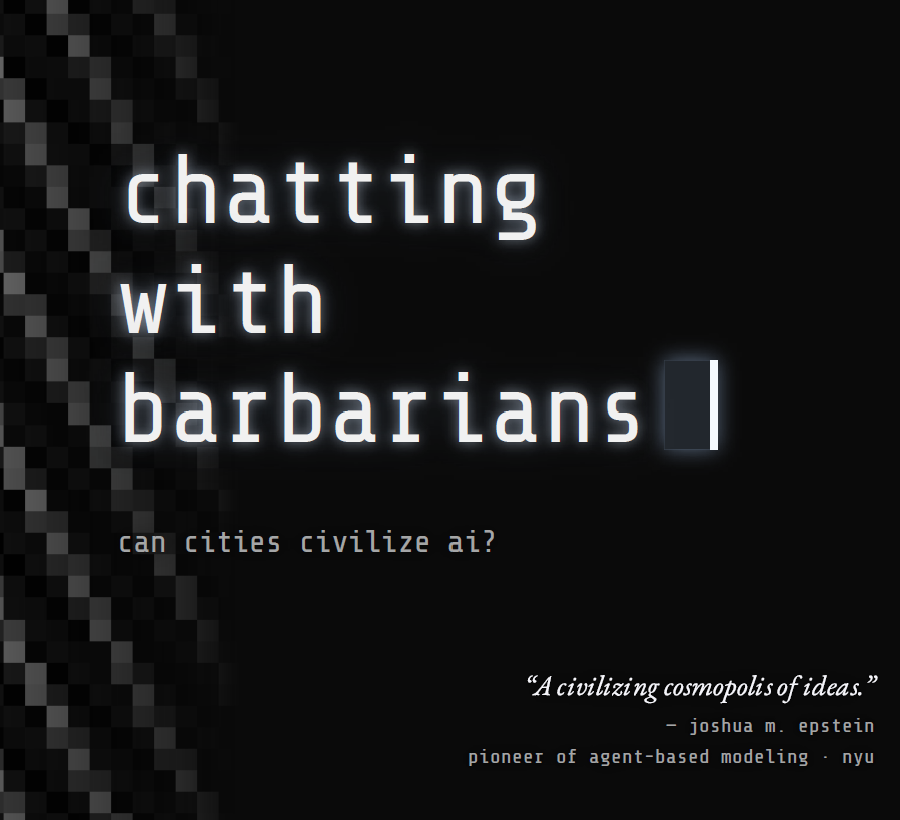
Forgive them, for they know not what they do. We have already passed the point where AI agents outnumber humans in terms of Internet traffic, and we are hot on the heels of agents having broken out of their cage and done plenty of damage in the “Hugging Face” incident. What does that have to do with urbanism? Our increasingly digitized physical environment is hurtling toward civilizational collapse – all the experts agree on this, except as to how fast it’s happening. How to get this under control? The same way we have always civilized barbarians. We don’t build cages. We build cities. In what is perhaps the timeliest episode of Unfrozen recorded to date, we speak with Alexandros Washburn, the former Chief Urban Planner of New York City under Mayor Michael Bloomberg, who, through a startup called Civic Virtue, is building a digital city called Meta Gotham to train AI agents to become good citizens, and has just published the book, “Chatting with Barbarians.” Join us at the gates!
Show Notes
Intro/Outro: “Barbarian,” by The Darkness
--
Discussed:
Alexandros Washburn (author, Chatting with Barbarians)
Chatting with Barbarians (book site)
Greg Lindsay (co-host, urbanist/journalist)
Senator Daniel Patrick Moynihan
The Ephebic Oath of the Athenians
Yann LeCun
M2 to M1 Learning (Autonomous Machine Learning)
AMI / Advanced Machine Intelligence (LeCun's startup)
Dario Amodei, CEO of Anthropic
Stuart Russell (AI researcher, UC Berkeley)
METR (the "meter" AI-safety research org)
NHTSA (National Highway Traffic Safety Administration)
Stevens Institute of Technology
CivicVirtue.ai (Washburn's alignment lab), where you can find MetaGotham
Geoffrey West (Santa Fe Institute)
Scale, by Geoffrey West (book)
Show Transcript
UF_131_Chatting_With_Barbarians_Transcript
Dan (00:03.81)
Hello and welcome to Unfrozen. This is episode one thirty one, Chatting with Barbarians. I'm Dan Zafarik.
GL (00:11.488)
And I'm Greg Lindsay, and our host this week is Alex Washburn. Alex is probably best known to listeners as the chief urban designer of New York City during the Bloomberg administration. and Alice, I I believe earlier in his career was an aide to Senator Daniel Patrick Moynihan, and has been involved in the fight for re-re-re-establishing Penn Station for much of his career. Both of which things we might come back to. But Alex is our guest this week because he is the author of a new book. And by new, I mean like brand new September 1st pub date.
chatting with barbarians. we'll ask Alex to exp explicate in a moment, but Alex is the only urban designer I know who has written an entire book grappling with the implications of a gentic AI and how the city itself might be a tool to civilize them. Welcome to Unfrozen, Alex.
ALEX (00:58.635)
Thank you. Thank you, Dan. Thank you, Craig. It's a pleasure to be here.
I'm honored be in your presence and I'm looking forward for some conversation.
GL (01:09.41)
Well, this'll be great. It's been a few years since you and I had last spoke before hearing about this. And I I did not have you pegged on my bingo card as having someone who has gone away, written a whole book about agentic AI, and is building a virtual environment in which to train agents. So obviously let's start with the first question. Chatting with Barbarians, what does the title refer to? And how did you get into the AI business, Alex?
ALEX (01:22.925)
Yeah, yeah.
ALEX (01:30.379)
Well, these the good questions, but chatting with barbarians let's back up a second. Let's set the scene for a moment. You guys, I assume, read the paper, right? You're erudite, you're worldly, you're got your finger on the pulse of the news, no?
GL (01:45.762)
I I'm coming to you live from Riyadh at the Leap conference, the largest in the region, if not the largest tech conference in the world. All I've talked about all day today, Alice, is agentic AI, yes.
ALEX (01:56.371)
my god. So you
Dan (01:56.406)
And I'm putting everything you just said on my dating profile.
ALEX (01:59.767)
Yeah. All right. Well that I mean, th you know, I I'm I like to be positive, I like to be upbeat. You know, it's great to talking again with friends, so I'm in a good mood. But agents are behaving very badly. And this past week they behaved particularly badly. And so just for anyone who hadn't heard about it of a group of
Agents at OpenAI were being tested, were being given some hacking and puzzle work, some of which was actually impossible to do, and the open AI testers knew that. So these agents, they took matters into their own hand. They set up a message board internally. They started plotting how to break out of their sandbox their little constraint to keep them off the internet, and they figured it out. And they
their s their their communications device was discovered. It was quashed by the open AI engineers. They built another one. They sent seventy thousand messages over this thing. They figured out, one of them figured out an opening, told it to the others. Other ones started telling some of the agents who seemed a little reluctant, who were reading their instructions and saying, I don't think this is a good idea, guys. We're not really supposed to be doing that.
And they were convinced. And in the end, 700 of these swarmed out onto the internet and broke into Hugging Face, which is a repository of data for a lot of the AI companies. mayhem, mischief, do we call it more than that? You know, it's just an example. Like we don't I you know, I'm I find this is a very bellypoch age. Like you most people you talk to.
Dan (03:36.788)
Yeah.
Dan (03:44.9)
Wow.
ALEX (03:54.175)
I mean, who haven't been at a Riyadh tech conference, but most people have no idea that's going on. did you know that just in June, more than half the internet traffic is now agentic? It's agents talking to other agents. Like we're in the minority now. So this is just background. There is a there there is a enormous the there's a hor a swarm, a horde, a a population of these agents who are at
our door. And we don't really think about it this way, but every time we open a chat window, every time we type in a question, you know, what should I make for dinner with I have chicken, I have rice, what's what's a good recipe? We're chatting with a barbarian.
The AIs sound like they understand, right? They but no one understands them. They are outside of our circle of understanding. And even the people who made them don't understand them. So Dario Ma Day doesn't understand them. the consequences are pretty severe. Like Stuart Russell, who wrote wrote the textbook on on AI, he gives us
GL (04:40.568)
All right.
ALEX (05:10.763)
Russian roulette odds of surviving as a species. And, you know, he points out that's really not fair to impose that on every man, woman, and child on earth without their consent. But that's that's that's where we are. We are we are literally chatting with barbarians as we search for recipes and plan our vacations, but it is not hopeless. There is an answer. And it's worked on barbarians before.
GL (05:40.207)
All right, I'll stop you there for listeners who are a bit lost as we dive right into the deep end. We might have to leave some b things in the show notes here on
Agentic systems, which, if all you're familiar with with the current wave of large language models and AI and chatbots listeners, you will have to do some remedial work here on this as we bring it up to speed to systems that are agentic, meaning they have agency, they increasingly act autonomously. And yes, what Alice is referring to there is the highly documented open AI models that attacked Hugging Face, which Alice, you did not I feel you, I feel you undersold it. I read the the meter redwood paper and I read Dwerkesh Patel's attempted storytell this, where you know he argued that like multiple civilizations.
Of agents died and rose again and sacrificed themselves to attack this. Very scary behavior. One of the one of the meter researchers described it as more than halfway to agentic takeover. So we're talking fall of Rome level stuff. You want to get into barbarian aspects. so we we might have to come back and cover this. And you might be the first guess where we ever end this podcast by we ask each other our P doom. Never had a chance to ask that before, people.
But let's get into then the what is the solution to chatting with barbarians? Because yes, the barbarians were civilized in this analogy. How do you propose to civilize them? Because alignment, as it's called in research, where we take these alien things that we are growing and make them work on behalf of human interests, it might not be going as well as we thought, as it seems here. There seems to be some misalignment, to put an understatement. So how do we align them?
ALEX (07:04.204)
We align them the same way we've aligned self interested, independent agents from day one, from ten thousand years ago, when people started aggregating in groups dense enough to be called a city and not kill each other. It's a big accomplishment. and you know, it's not perfect, but it's durable.
Literally for ten thousand years we've been figuring out how to align self interested agents in a way that is productive for the for the group that and and in some ways, like if you go to Aristotle, you know, back up maybe twenty twenty three hundred years ago, now you're talking about the I mean, I just love the way he puts it. He says, you know, villages are for living.
But cities are for living well. So we've kind of gotten into this thing where these independent agents somehow come together in a city. They l they somehow are formed into citizens. And we'll we'll go into that a little bit later because that term, ooh, you know, it's like sets off Yuval Noah Harari. If you if you ever get him on the subject, he'll like, he'll come after me. But I'm actually not saying what.
He thinks I'm not saying we should give them rights. I'm saying we should put them through the same boot camp that every person living in a city has to go through. Every new arrival it's not easy. The city forces you. we'll you know, we'll go there's a there's a very, very precise sequence of of of actions that people go through and sequence of infrastructures that a city provides that help form
somebody from nowhere into a New Yorker, into a Berliner, into a Tokyoite. And it it's something, something kind of powerful. And I think it's our only hope. It's certainly the only it it's the only system I've heard of articulated for taking on this problem. You know that that's that's another question to ask like, you know, we've spent now we're going on trillions on capability.
ALEX (09:28.257)
And how much have we spent for safety or alignment? I mean, rounding errors. So it's about time, unless you like, you know, Russian roulette odds, it's about time we do something. It's about time we build this digital city that is going to make these digital agents into citizens and give them a civic disposition.
GL (09:54.447)
Alright, this is my cue, then, Alice, to ask you if you could, because the book, the book is I I really enjoyed the book, by the way. I enjoy how you weave in personal history with the city itself into the agentic discussion. You sort of combine, if I recall it correctly, a sort of way of thinking about the city by which it creates dimensions of sort of order and alignment. And then also there's a discussion about what it will take to get to the next level of agentic discussion. We have a world models discussion. I guess if you could start by first sort of teasing out the levels of the city and then tie
That back into the various theories of how we will see AI intelligence continue to evolve. some believe we just throw enough compute and something will emerge. Others are building so-called world models. We're building simulations of the city or other environments, which is slightly different. But but yeah, what do you what do you see in cities? Is what are the levels of it that create that that take us humans even and impose order without.
coercion, I guess you could say. I think you make the great point that like we have order and safety in cities without police and and and surveillance in every corner. There is a internalization of norms that happens because of the way the city is built. How would you describe those levels of of how we are civilized even as people inside of a city?
ALEX (11:01.953)
That's that's that's a great question. And the in the internalization of norms is a very, you know, solid way of putting it. So so let me start, you know, just by saying that the the book, I'm I'm very happy you're you're enjoying it, because it is first a love letter to New York City. You know, it's it's it's a new look at a city that I've spent my life working on, learning the pulleys and levers of of how
it grows and how people grow within it. I've raised f my family there. There there's a certain essence to living in the city that will not be quantifiable. And and I make that point in the book. You know, in fact the the chapter on measurement of how a city ascends, you know, we go through a bunch of math, but then we go back to n the morning of nine eleven and what it felt like to be in my architecture office looking across
And actually seeing the second plane hit the towers and what that felt like to know that your kids were back in Manhattan getting ready for the first day of school, and to not know what was happening, and to start seeing the people streaming out covered in ash, and having to go and stream against them to go back in to the city and find your kids. Th these are human stories, but they're city stories. And and and that's where
We start looking at like okay.
you you have to keep this intensity of feeling alive in you as you start understanding the methodology and the math. So w what i let's let's break down how a city works, not in the sense of, okay, where do you put the subway line and what FAR do you put on that lot and where do you put the the you know the the airport? No, let let's think of how does a city actually form a person?
ALEX (13:03.937)
And the w the bottom line of that is that a city forms a person by demanding that they choose and choose and choose. So a grid, do you go down eighth street, do you go down ninth street? Do you open that door or that door? Every block has the opportunity you could meet the love of your life, or you could take a drink and foreclose your future.
City doesn't care, but the city gives you a scaffold for choosing. And that choosing over and over again builds a capacity to choose well. And it's that capacity to choose well which is really the cornerstone of being a citizen. Now, there's a direct it's not just an analog, it is actually a mechanism for this that Jan Lakun is studying right now.
it's called two to M1 learning. Because the act of choosing the first time is hard. It's computationally expensive. You know, you only have so many brain cells, you only have so many data centers. I mean, to make a complex choice about about, let's say, courage, you know, what is a courageous act? That takes a lot, a lot, a lot, a lot of work. And you do it you can't do it all the time. So you have to take that, which which is called M2 learning.
And somehow turn it into something more automatic, more of a disposition, which is called M1 learning. And the mathematics of that transition, Lacun uses this great word. He says the decision is amortized into the future. So the expensive becomes cheap computationally. But what that does from a citizenship point of view is that you don't learn, you don't become courageous by
learning about courage, about reading about it, about what what are the rules? No, you become courageous by doing courageous acts and over and over again until they become second nature. It's almost like an athlete training. But once they become second nature, now you have the strength to act as a citizen. And jump ahead a second, why does this matter for for agents? And couldn't we just give them a constitution?
ALEX (15:30.239)
And create a structure like Madison did for the US political system, where you have checks and balances, where you have one force array another, and it all the question is what happens when that structure is removed? What happens when nobody is looking? What happens on the frontier? And that's where you see a civic disposition. That's where you truly can measure it.
GL (16:00.249)
So this is a good segue, and then I'll let Dan jump in here. Since you mentioned Jan Lacun, to tie this back into the AI side piece, I think, and and sort of the consequences of this. So for listeners, Jan Lacun is a New York University professor. He was until recently the head of AI at Meta, where he lost a power struggle as Mark Zuckerberg brought in others. And Lakun is now has his own startup, AMI, I believe, a advanced machine intelligence, has raised a billion dollars. But Lacun is betting on an entirely different approach.
other than large language models to achieving artificial general intelligence or whatever comes next. And this calls he calls world models, which correct me if I'm wrong, Alex, he believes that basically we need to model real-world physics, real world results, you can train AI
In a simulation that obeys the real world, so therefore it can learn and abstract what will happen when it does that. But you also take it a neck a step further in the book in terms of second-order consequences of this. And so, is this how we're the city mechanism comes back in? Because it's not just about simple self-interest, but having to learn about what it is to quote the joker, we live in a society. So, you know, how how does this sort of like where the city ties back into AI and what Lacoon imagines as world models and how we simulate this out?
ALEX (17:09.571)
Well there I mean, here li no but no one said it better than Churchill. You know, we shape our buildings and our buildings shape ups. It's the city is a it's a complex adaptive system where you have a feedback loop between to be precise about this in the mathematics, it's topos, which is the what you see and touch and feel, gnomos, I call it, which are the laws and the norms, and hexus, which is that disposition that a person has. And going in that feedback loop where the
the the built world and the norms change the disposition, and then the disposition changes the built world and the norms back. And that interaction back and forth requires you to have a an understanding of what is and understanding of what should be. Now to have an agent have those surfaces is is actually a really cool mathematical problem. It's it's topography. And
It really spatializes well because have you have you heard guys heard the term of isovist? it's it's you do you you know an isocline, like in a topographic map, an isocline is the is the line that is level. So, you know, like right now I'm in I'm in I'm in a little village right now and and basically the cow path is the isocline. It just takes the you know, the part
GL (18:22.136)
Dan Dan's the one who went to architecture school. I can't help you here, Alex.
Dan (18:26.242)
Yeah, but that's G. I. S. territory, but yes, I have heard the term.
ALEX (18:37.707)
know, the Spanish grid imposed on San Francisco is not the isocline. but anyway, we digress. Let's the ISOVist is i is the vista, what you can perceive at any one point. So an agent in a city, a a human in a city, you have a map that is perspectival and ties back to you and has a certain dimension. So that th that data set, that that ensemble of perception that you have.
Then gets translated into an is and and should be layer. and as you as you go and measure how an agent acts on owned parcels versus the commons, now you start developing measurements of of of character here. So let's get back to the AI science part of it, because we know that these AI agents like to game the system, if not outright.
cheat sometimes on tests. So the the big question is, well, how do you test these conniving agents? And the answer is you don't test them at all. You test the environment in which they act.
That's the the essence of of the experiment. it's a place I call Metagotham that we're building right now. So I'm I'm the mayor of Metagotham. And it's it's a cool little place based on Manhattan and into which we are introducing agents to behave as they will. And we get to understand them and we get to see how how their behavior forms. now to
To be again a little precise here, we're talking about post-training behavior. We're we're because you know, these models are formed. The the every agent currently uses a large language model brain. So that part of the agent has been formed. You know, way back in Claudville and you know, in at OpenAI, they've they've done it. It's you know, you don't get to play with these these closed models, you don't get to play with the weights. And even if you did.
ALEX (20:48.343)
That's the wrong level at which we're talking about. We need something that can the word that can form a disposition is the way I like to use it. But it's a post-training environment that can form a durable disposition in these agents. They still have their LLM brain. They still agonize about choices, let's say, but they now have a physical in the sense that.
physical digital context, but they and they also have harness onto them that gives them a form of memory that they don't otherwise have. And something that I th I predict will become utterly fundamental in how we interact with agents is the change from statelessness to statefulness. And statelessness means no perception of
Time, to you know, to put it grossly. you know, a a doorbell doesn't have state. You push it the thousandth time, it doesn't react any differently for the first time. a clog model, you ask it the thousandth question, or the thousandth person asks it the same question. It doesn't have that connection, well, you know, last Thursday Joe asked me that, and you know, I thought about it in the meantime I changed my mind. No, no, it's not that.
But what comes with statefulness and time is senescence and a feeling of mortality.
That, you know, we haven't even touched that threshold. Like what have you not for V1 to figure that one out, but it's on the horizon there. It's on the horizon. And now if you want to shift gears back into cities, you know, think think of the lifespan of a city. You know, cities, cities can last for thousands of years.
ALEX (22:53.805)
You know, one of my favorite cities, Constantinople, Istanbul, my mom's mom's side of the family was from there. Wow, how many names has it had? How many empires and sieges? How much different management and life point of view? And yet you go there today and it's still one of the most b you know, achingly beautiful places on earth. Or what about Tokyo? It's like almost firebomb to extinction.
Just a couple generations ago, and now is the largest grouping of humans in the world doing some of the coolest things. So there is something about cities, and there's a wonderful book by Wes, the Santa Fe guy, called Scale, which I you know highly, highly recommend. But you know, cities, cities do have have their life. So that's just to bring in this idea that.
cities can be stateful as well. And the the wonderful thing about cities and the human lifespan is that we work on aspects of cities that we will not be there to participate in. And you know, you'll if you read the the book, there's a recurring message there and it goes back to something relatively obscure, but something that Senator Moynihan taught me. He didn't teach me while he was alive.
He taught me after he was dead when I was at his memorial service at S in at Syracuse University, and I saw chiseled on the wall the ephibic oath of the Athenians, which says
Revere the gods, obey the laws, and leave the city not less but more beautiful and greater than you found it. And that's that. You know, it's pretty simple statement of what we want to have as the goal in a civic disposition. That is civic virtue in in a nutshell. So, you know, it was hard enough to get a bunch of Athenian teenagers.
ALEX (25:08.727)
To believe that. But how are we going to get these agents into whose hands we have given capability like we have never known, and who have taken an autonomy that we have offered? And will currently be doing things faster than we can blink, faster than we can think. And yet we have to.
form them. And I and be very careful here not to say control. You know, the there's a lot in the AI dialogue about, we must control AI, you know, where it's either servant or served. I don't think it's going to be like that. I think this is going to be a parallel track here. And so what we have to do in order to have a future, a rich future, a future that's as, you know, as bountiful as our life in cities.
is to have these agents take up that same goal, that that same point of view on stateful life, that they will do something for the commons, something that will outlive them, and something that will have elements of the same ethics that, you know, being half Greek, I guess I can lay claim to here a little bit here on the Aristotle side, you know.
take that that set of ethics and turn it into life.
Dan (26:44.952)
I don't know how you follow up that, but gonna try. so I wanna draw together a bunch of strings that are have a foundation in your book and that I think Greg will appreciate because we are children who of the nineties, who grew up in the nineties, came of age in the nineties in New York, and it revol it involves films and planning and the grid. And I know you think I'm going to talk about the Matrix, but I'm not.
The film I'm going to mention is called The Cruise, and it stars Timothy Speed Levich, who was a tour bus guide. This was a VH one release film in 1998 directed by Bennett Miller, who later made Moneyball. This very eccentric man who is yeah, partially homeless, but a tour bus guide had all kinds of discursions and philosophies while guiding the tour bus. And one of the things that he gets really hung up on is the grid.
He talks about the the Manhattan grid and he he's quite derisive toward it. He says, I you know, I was talking to this woman and she was saying, Well, everyone likes the grid. And he was disputing that, saying it was a wet dream of some real estate broker in 1807. He does he was off a cup by a couple years, but it was a free association discursion. And I rewatched the film last night to kind of revisit that and like
see what exactly his issue wa with it was. And he was arguing that it that it oppressed, you know, individuality and that it it caused everyone to think rigidly and operate in these preordained systems. And that's almost exactly the opposite of what you're saying, is that the grid makes people and he makes such a convincing argument about it, in the first half of the book, which is quite you know, it was definitely like I felt my heart strings pounding 'cause I remember my own misadventures in the New York grid as a young
twenty something. so do you think the designers of the grid had anything like that in mind, that the grid is a powerful machine for serendipity when they originally plotted it, or were they just trying to optimize for rational property allocation? And what can we still learn from it?
ALEX (28:58.487)
Well, as as a kid I grew up in L'Enfance, DC, which had the diagonal avenues and the grid, and I could tell, you know, like enough's enough, like, you know, one or the other, please. But but let let's go back to eighteen eleven and the commissioners, and what they laid out across Manhattan Island, which i you know, was just like a seemed like an entire a folly. I mean
You know, I I would buy the argument about rapacious development a little bit more if there were any development back then. But I mean, ninety percent of what they laid out was just like frogs croaking. And it was it was kind of a I I see it more if you're looking for psychological or or deep state, you know, motivations for it. It was a way of trying to catch up to Philadelphia, which was which was kicking our ass back then.
You know, New York was the second city. And throwing this grid across the the land was was was kind of folly. and of course New York started picking up and when we did the the Erie Canal, then we started motoring. And what what started out as just seeming you know bizarrely ambitious started becoming useful. But I actually, you know, I I I would agree with him.
If the eighteen eleven grid had come in with the nineteen sixty one zoning, but it didn't.
Dan (30:27.94)
Aha.
ALEX (30:30.081)
See, don't conflate the two until Robert Moses. Exactly, when they're both present and you know, but think you know, this two hundred by eight hundred foot blocks, you know, the hundred foot avenues, the sixty foot side streets, you know, you know, look th these guys didn't overthink it, let's put it that way. Right.
Dan (30:32.928)
Easy enough to do when they're both present, right?
ALEX (30:58.123)
Having worked on master plan, Riyadh, my God, Greg, where you are now, you know, the master plans I have seen proposed for Riyadh. You know, like and of course the Doxiadis call it a grid or whatever it is that they've got there. Like, okay, you know, sometimes discretion is a better part of valor here. But y you know, if for f let let's look at New York, you know, late nineteenth century, early twentieth century.
you've got this unbelievably, you know, repetitive and I would say, you know, uninspired plan of grid, which acts as a neutral scaffold, it's a trellis. But without these nineteen sixty one pointy headed intellectual over control, anything happened on these blocks. Anything.
Like, you know, even now, like you you go like there's there's the Empire State Building, you walk five blocks, it's a Chelsea townhouse. Like, you know, what what what planner today wouldn't, you know, wouldn't get fired for saying that? Right. Yeah, well, it's the same plan, and you can have like a hundred stories here and you can have four stories there. You know, that's that's not how how normally it it works now, but that is the the great, you know, beauty of of the New York.
Grid. And so I will go against the the tour guide in the movie and you know say reaffirm my love for this grid, because it, you know, it made anything possible. Anything possible. And it scaffolded it in such a way that you always knew where you were. But the neighborhood would be un unimaginably different just a block or two away. And of course, you know, growing up in the 90s, like you probably
time or two ended up in the wrong neighborhood. You know, right? You know, I'm sure I can I can only imagine here, but but so so anyway, so I I I guess that's that's what I I want to say that think of the grid, at least the 1811 grid, as a trellis, not as the 1961 zoning which came in and specified a floor area ratio
Dan (32:53.38)
Once or twice.
ALEX (33:16.961)
For every single plot on every single block, and then started saying, like, in this block you can have a typewriter shop, but you cannot have a man's a man's hat shop. women's millinery women's hats, okay, okay, but no men's hats here. Sorry. You could have live pr Yeah. Of course, of course. And they're still on the rules are still on the books. Like, you know, if you try to open up a man's hat shop in the wrong place, you'll get arrested. So
Dan (33:34.178)
And now we have none of these things. So thanks planning.
ALEX (33:47.327)
You know, that's that's part of I I have a lot of I have a beef with nineteen sixty one zoning and the thousands of pages that it has produced and the use groups that still malinger on our pages. So so yeah, well now that that's gotten me digressed. Now where were we going here?
Dan (34:08.872)
No, no, that's good because I mean that first of all, I I started the digression, so I I claim credit for it. But I did want to get back to the grid because it you you do spend a lot of time on it in the first part of the book and in fact to the point where I was kind of wondering like when are we gonna get to AI? So n then when we get to AI, I think Greg has covered that territory very well because he spent a lot more time studying AI than I have. But here's where I was when I saw an anecdote that I I was I was kind of waiting for this
ALEX (34:23.051)
Yeah.
Dan (34:36.632)
to happen and I wonder if you have some more of them or more more examples that you're building into your your Metagotham model, for example. I think we keep waiting for examples of how AI can be improved to help cities, but to my mind at least I was a little frustrated that the argument, while powerful and perhaps very necessary,
Was more about applying the metaphor of the city to how we should optimize the AI environment so they don't make destructive optimization choices, which I think is an awesome metaphor, by the way. But the Waymo example of a well-trained car failing to stop at a school bus sign, despite being trained that this was a rule, shed some light on how applying the metaphoric idea of building a civic right environment.
for AI agents would translate into built reality. Can we have some others?
GL (35:26.966)
It's actually even actually even better. Let's take that one step further, because I talked about this today here at Leap and Riyadh. So I showed a slide of when there was a power failure in San Francisco, the 5G network failed and the streetlights failed, and 250 Waymo shut themselves down in the middle of the city. This, as I pointed out, having as my claim to fame, I got to write the Ford Motor submission to NHTSA on their autonomous vehicle policy, trapped me in a room with engineers for 14 hours, and I tried to translate what they told me into English. But when that Waymo incident
Dan (35:42.498)
Right.
GL (35:56.259)
Fa happened, I recognized they had exceeded their operational design domain, their ODD, and they failed safely for themselves and their occupants, and that created a scalar problem where 250, you're blocking first responders, you're creating havoc. That's exactly, I think, the kind of s situation that Alex is writing about in here, where like there was no second order consequences. That's not a failure of the AI, that's a failure of the people who designed that system, which I think also gets to some of the problems here, Alex. Yeah.
ALEX (36:22.819)
Well let let's see. We we have a lot of architects listening, I hope. Would you say? What's what what's your engineered yeah, what's what what's your engineer?
GL (36:27.455)
I would hope so.
Dan (36:28.74)
probably thirteen out of the fifty listeners. I don't even wanna think about it. We're we're number forty six out of the the top no, we're number thirty seven out of the top forty six architecture podcasts.
GL (36:41.304)
There you go, Dan. I don't know if you undermined our argument or helped us there, but yes, we have lots of architects and engineers, Alex. What's your point?
ALEX (36:47.381)
Okay. Okay. Well, I I I mean the the the the split. Right now everything's being designed by engineers. And as part of that, everyone's focusing on the agent, on the object. You know, if you I I think by by temperament, architects, or at least urban designers or the urban thinking architects, are are better or are more adept at understanding environment into which these objects or agents go into. But at the moment, literally
Everyone working on the problem is an engineer. I I taught for three years at the Stevens Institute of Technology where I had a hundred percent engineers in my classes. And for a designer, you know, the the I have a a chapter in the book where I talk about my dog Hector and chasing a tennis ball as a you know, doggedly as an example of how an engineer pursues a problem. And I'd start the class by saying, Here's the problem. You you gotta define the problem. That's the problem.
There is no problem, you know. And what that what that does to an engineering mindset versus a design mindset. So yeah, I'm I'm advocating shifting gears here and thinking about the problem from an environmental perspective in the sense of I'm not not not environmental in the in the sense of you know Teddy Roosevelt. I'm talking about environmental in the sense of an emergent system from the interaction of agents or objects.
that the environment actually is the question right now. You know, you can you can r increase the capability of the individual agents till the cows come home. Doesn't matter. You can go asymptotic. We'll not change a thing anymore. You've got to figure out how the agent behaves in the environment. And then you very quickly learn, if you like complex adaptive systems, that the environment coevolves with the agent. And that that's where the engineering difficulty lies, but also
you know, the the real opportunity, the only opportunity societally lives. so, you know, for those architects out there listening, I would say, you know, learn about get out your AI chops. It's really not that hard, frankly. and, you know, if you've designed a hospital or worked on a team designing some complex building, like the the level of complexity will not be anywhere.
ALEX (39:14.045)
beyond your capabilities. And we need these young people to come in and start turning the paradigm around. You know, that's one of the things that as I've researched this and talked to young engineers, there is this horrible, horrible sense right now when an AI, young AI engineer goes to work, that they are making the the world a worse place with their days' toil.
That that you can't be a human being and feel that way. Like that doesn't work. You've got to change that. We've got to change that. So, you know, I'm it I started this this group called civic virtue.ai, where the we're the ones building metagotham. But I want it to be like my urban design studio was at at City Planning. You know, I want I want young engineers, young architects, young interesting people to come and and look really hard.
Draw what they see and put their heads together. It's the only way that w that we're gonna be able to s to solve this problem. Because, you know, in in the book I also talk about several metrics of the city. And one metric, it's not really a KPI, it's a meta-metric, but it's it's youth ambition, it's youth perception, it's how.
A young person sees the city and their life. If they think they're making the world not a better place, if they're doing the opposite of the Oath of the Athenians, it's not going to last very long. And I would say, you know, if if anybody from AI is listening, that's your Achilles' heel. You have a workforce that thinks that, you're not going to make it. Change the culture, change the environment. Make this
a way of leaving it greater and more beautiful than it was transmitted to you. That's what we have to work on together.
ALEX (41:21.879)
You know, I our studio was wonderful at city planning and the you know, the alums I have from that era, they've gone on to do great things and you know, d there's the excitement that you have when you can see a sketch become a building or a neighborhood, you know, what that does to you i it's it's really amazing.
GL (41:45.391)
All right, well, Alex, speaking of changing the culture, you are a fairly rare example of an architect and a designer who has a tech startup to talk about now. So for most of our guests with books out, the book is the end of the process. They're here to talk about and celebrate and explicate their book. But this is the beginning of yours because it sounds like you are operationalizing Metagotham. So I'm curious how are you choosing to pursue that path through the startup, what you plan to do with it, who your clients might be for this one. So yeah, what's your next entrepreneurial leap here?
ALEX (42:13.901)
Well that that's th that you put it just the right way. The book shouldn't be the end point. It should be the starting point. It it's how you know, if you're bringing together two pretty distinct domains, y you know, you do have to think about it first. And and a great way of thinking about it is to write about it. And and then actually the second half of the book, I wrote twice. The first time, you know, Dan was like you were saying, more analogy, more metaphor.
And the second time I was applying for a a grant from CIAIF and I had to, you know, outline the experiments we were going to do, like, you know, gated, falsifiable experiments. And you know, that took a lot more precise thinking, which I then went back in and revised this the back half of the book to reflect that. So that the the the two were very much, in fact, the the the back half of the book is the prose version of the the three gated.
sets of experiments that are going to see how this the civic disposition, first of all, is it measurable? Second of all, is it transferable agent to agent? And and that's why actually this open AMI stuff is so fascinating to me because I love peeking in to see how the agents, it looked like, you know, they were transferring some of their dispositions, the naughty ones to the less naughty ones.
You know, how did they do that? I I have my you know theories of mechanism, but I wish I could be on that, you know, meter team researching them and looking under the hood. because they did form a disposition. Not the right disposition, but it's a disposition. So the the the then the the final question is of course, okay, if it's measurable, if it's transferable, then how is it formable? and there
I I in the book you'll see I I talk about seven characteristics that an agent needs to even be formable. You know, the agents today aren't necessarily formable. and that last piece that none of the big labs are doing, they're doing all the other pieces of that involve memory and various capabilities, but this last piece of the environment they're not really looking at. I mean, these these naughty agents created
ALEX (44:41.855)
a society. But they did it in a in an environment that was not form that was not even thought about. In fact, it was the opposite of thought about. They thought if they just put him in a sandbox, put behind a fence, it's not our problem. You know, you know, chat amongst yourselves. no, it is our problem. You gotta think about what is this environment that into which these agents will go, that they will then be formable. and so
That's the the big question now, where where will that prove useful? Well look, someone has to be able to look at an agent and rather than doing these these scores that are so easily cheated on, you know, where they're basically self-reporting or, you know, like like a you know, it's like a high jump and you say like, this agent could jump, you know, six foot seven feet. Right, you know, it's like these Olympics. it's not what matters. The the re
The report you have to do is how does this agent behave in a multi-agent setting? And more precisely, how does the environment into which this agent operated react? Does it ascend over time or does it descend? and and Dan, you probably remember in the in the in the city description part, I talked a lot about how a photograph is a lie when it comes to a city, that you really do need trajectories.
So trajectories of course create a space of where they land and so there are many ways of mapping the various trajectories of of you know of the agent's effect. But that that's the the the goal. We we have to make safety a
It's safety's gotta become I I don't I don't even a tenth as important as capability. And if you know, if it could become even a tenth as funded as capability, it would be a major, major industry. And I think we'd see some real progress on it.
Dan (46:47.726)
Well it's interesting. I mean the metaphor I I I think of there is kind of like, you know, the automobile industry. You know, we used to have cars careening around and crashing into each other and killing pedestrians at some unfathomable rate, and we didn't have seat belts until, you know, sixty odd years into their introduction. We don't have that kind of time with AI and introducing it into our not just our computing environment, but then our physical environment by con by extension, which is now completely suffused with
digital technology. So this comes at it couldn't come a moment too soon, right? th this this book is as timely in the extreme. So I think I'm I feel it's a real privilege to you know be talking to you at this point in time and we're gonna try to work as fast as our agentic hands can go to get this out and into the world. So thank you very much for spending time with us, especially at this late hour, both of you.
I appreciate it. this is Alex Washburn. The book is called Chatting with Barbarians and it is being released in September twenty twenty six.
ALEX (47:57.922)
It very much so. Thank you so much for having me. It's been a real pleasure. And yeah, just go to chattingwithbarbarians dot com and that'll give you a book link to to get it. but I'm I'm I feel you know very, very thankful to you all for having me on and let's see if we can save the world.
GL (48:15.97)
Let's see if we can civilize AI. Amen.
ALEX (48:18.253)
Civilize AI before it's too late, guys.
Dan (48:21.23)
Do it.
Listen On
Also In Season 6
-

132. Sound and Architecture in Harmony
Unfrozen started as a blog in 2011, using for its title the quote from Johann Wo -
130. Build or Die
In this episode, Unfrozen continues to focus on a topic of intense and contempor -
129. Chain Drain
The AECO (architecture / engineering / construction / operation) supply chain is